 Enlarge this image
Advocates and victims of the opioid crisis gather outside the U.S. Supreme Court on Dec. 4, 2023, while the justices hear a case about Purdue Pharma’s bankruptcy deal. The protesters urged justices to overturn the deal, which would give the Sackler family immunity against future civil cases related to opioids. Aneri Pattani/KFF Health News hide caption
toggle caption
Aneri Pattani/KFF Health News
Advocates and victims of the opioid crisis gather outside the U.S. Supreme Court on Dec. 4, 2023, while the justices hear a case about Purdue Pharma’s bankruptcy deal. The protesters urged justices to overturn the deal, which would give the Sackler family immunity against future civil cases related to opioids.
Aneri Pattani/KFF Health News
In 2023, state and local government received about $1.5 billion in settlement funds from more than a dozen companies that manufactured, sold, or distributed prescription painkillers and were sued for their role in fueling the opioid crisis.
That money has gone from an emerging funding stream for which people had lofty but uncertain aspirations to a coveted pot of billions of dollars being invested in real time to address addiction.
Altogether, the companies are expected to pay more than $50 billion to state and local governments over nearly two decades.
Meanwhile, more than 100,000 Americans have died of drug overdoses each year in recent years, underscoring the urgent nature of the crisis.
Explore the series
Opioid manufacturers, distributors, and retailers are paying tens of billions of dollars in restitution for their role in the overdose epidemic. We’re tracking how state and local governments use — or misuse — the cash. Explore the series here.
KFF Health News has been tracking the funds all year and covering the windfall’s mixed impact in communities across the country. Here are five things we’ve learned in 2023 and plan to keep an eye on next year:
1. The total amount of settlement money coming to state and local governments is a moving target
Before the start of the year, national settlements were in place with at least five companies, and several other deals were in the final stages, said Christine Minhee, founder of OpioidSettlementTracker.com.
Today, most states are participating in settlements with opioid manufacturers Johnson & Johnson, Teva Pharmaceutical Industries, and Allergan; pharmaceutical distributors AmerisourceBergen, Cardinal Health, and McKesson; and retail pharmacies Walmart, Walgreens, and CVS. Many are also settling with the national supermarket chain Kroger.
Several of these deals began paying out in the second half of this year, leading to bumps in states’ opioid settlement pots.
But there have been dents and slowdowns too.
Shots – Health News
Opioid settlement payouts are now public — and we know how much local governments got
Mallinckrodt Pharmaceuticals, a manufacturer of generic opioids, originally agreed to pay $1.7 billion as a result of its 2020 bankruptcy filing to state and local governments, as well as people directly affected by the crisis. But the company filed a second bankruptcy in August, slashing $1 billion from that figure.
Purdue Pharma, perhaps the best known of all the companies for its creation and marketing of OxyContin, had agreed to pay $6 billion as part of its bankruptcy proceedings. But the Biden administration objected to the deal this summer, and the case now lies in the hands of the Supreme Court. At its core is the question of whether it’s legal for the Sackler family to gain immunity from future civil cases about the opioid crisis under the company’s bankruptcy deal when they have not filed for bankruptcy as individuals.
The Supreme Court heard arguments in December and is expected to rule on the case next spring or summer. Until then, no Purdue money will flow.
Enlarge this image
Advocates and victims of the opioid crisis gather outside the U.S. Supreme Court on Dec. 4, 2023, while the justices hear a case about Purdue Pharma’s bankruptcy deal. The protesters urged justices to overturn the deal, which would give the Sackler family immunity against future civil cases related to opioids. Aneri Pattani/KFF Health News hide caption
toggle caption
Aneri Pattani/KFF Health News
Advocates and victims of the opioid crisis gather outside the U.S. Supreme Court on Dec. 4, 2023, while the justices hear a case about Purdue Pharma’s bankruptcy deal. The protesters urged justices to overturn the deal, which would give the Sackler family immunity against future civil cases related to opioids.
Aneri Pattani/KFF Health News
2. Most states still aren’t being transparent about how the money is used
In March, KFF Health News, NPR and Minhee published a comprehensive investigation showing that only 12 states had promised to publicly report how they were using all their settlement dollars. Since then, that number has inched up to 16.
But 15 states still have not committed to publicly reporting anything at all, and others have promised to publicize only a portion of their spending.
Many people aren’t happy about the secrecy.
In Ohio, a local advocacy group, Harm Reduction Ohio, sued the OneOhio Recovery Foundation, which controls most of the state’s settlement dollars, for violating public records and open-meeting laws. Although a judge ruled in favor of the advocacy group, it became a moot point in July, when the state passed a budget that included language exempting the foundation from such requirements.
In Michigan, the Department of Health and Human Services came under fire for not publicly reporting how it was spending upward of $40 million in settlement funds. In October — just hours before a legislative subcommittee hearing in which lawmakers asked critical questions about the money — the department launched a website, displaying a breakdown of organizations to which it had awarded funds.
At the national level, a dozen Democratic lawmakers have raised concerns about a lack of transparency and oversight via a Sept. 25 letter to the Office of National Drug Control Policy, which is leading the federal government’s response to the opioid crisis.
“We urge the Biden administration to closely track opioid settlement fund spending, to ensure that populations in need of additional support receive it,” the lawmakers wrote.
The Office of National Drug Control Policy responded this month that it did not have the statutory authority from Congress to do so.
“Currently, no mechanism exists that would allow ONDCP to require states to disclose their spending,” the office wrote in a letter obtained by KFF Health News. “ONDCP cannot effectively monitor how states use these funds.”
Enlarge this image
Carrie Spears lost her 23-year-old nephew, Tanner, to an overdose two years ago. She paused near a cardboard memorial marker for him at a Trail of Truth event in Washington, D.C., on Sept. 23, 2023. Aneri Pattani/KFF Health News hide caption
toggle caption
Aneri Pattani/KFF Health News
Carrie Spears lost her 23-year-old nephew, Tanner, to an overdose two years ago. She paused near a cardboard memorial marker for him at a Trail of Truth event in Washington, D.C., on Sept. 23, 2023.
Aneri Pattani/KFF Health News
3. Money is being spent on treatment, overdose prevention, and controversially, on law enforcement
Although there is no national data on how settlement dollars are spent, piecemeal tracking by journalists and advocates has surfaced some favorites.
One of the biggest is investing in treatment. Many jurisdictions are building residential rehab facilities or expanding existing ones. They’re covering the cost of care for uninsured people and trying to increase the number of clinicians prescribing medications for opioid use disorder, which have been shown to save lives.
Another common expense is naloxone, a medication that reverses opioid overdoses. Wisconsin is spending about $8 million on this effort. Kentucky has dedicated $1 million. And many local governments are allocating smaller amounts.
Some other choices have sparked controversies.
Several governments used settlement dollars to purchase police patrol cars, technology to help officers hack into phones, and body scanners for jails. Supporters say these tools are critical to crack down on drug trafficking, but research suggests law enforcement efforts don’t prevent overdoses.
People are also divided over school-based programs to prevent kids from developing addictions. While they agree on the goal, some people favor programs that teach kids about the dangers of drugs — like D.A.R.E. in the ’80s — while others prefer programs focused on improving mental health, resiliency, and communication skills.
Shots – Health News
Fentanyl mixed with cocaine or meth is driving the ‘4th wave’ of the overdose crisis
Perhaps the most contentious use, though, is shoring up county budgets and paying back old bills. Even if it’s legal, many people directly affected by the epidemic say this misses the goal of the settlement money, which is to address today’s ongoing crisis.
4. The settlements require companies to change problematic business practices, but that’s having unintended consequences
As part of their settlements, manufacturers like Allergan and Johnson & Johnson agreed not to sell opioids for 10 years and curb marketing and promotion activities. Pharmaceutical distributors were required to step up efforts to identify suspicious orders from pharmacies, under the oversight of an independent third-party monitor. Retail pharmacy chains must conduct audits and site visits to their pharmacies, as well as share data with state agencies about problematic prescribers.
The goal of these stipulations is to prevent further misuse of prescription opioids. But some people see unintended consequences.
Distributors have placed stricter limits not only on pharmacy orders of opioids, but on many drugs considered potentially addictive, known as “controlled substances.” As a result, orders for these medications are being canceled more often and some pharmacies are hesitant to fill prescriptions for new patients. That has left people struggling to obtain medications for chronic pain, anxiety, attention-deficit/hyperactivity disorder — and, ironically, even medication that treats opioid addiction.
Bayla Ostrach, a researcher in North Carolina who studies substance use and health policy, said buprenorphine, which is considered a gold-standard treatment for opioid use disorder, was already difficult to obtain at many community pharmacies and in rural areas. But the settlements appear to be making it worse.
Instead of increasing access to treatment — which is critical to stemming the number of overdoses — “I really worry the settlements may be having the opposite effect,” Ostrach said.
Enlarge this image
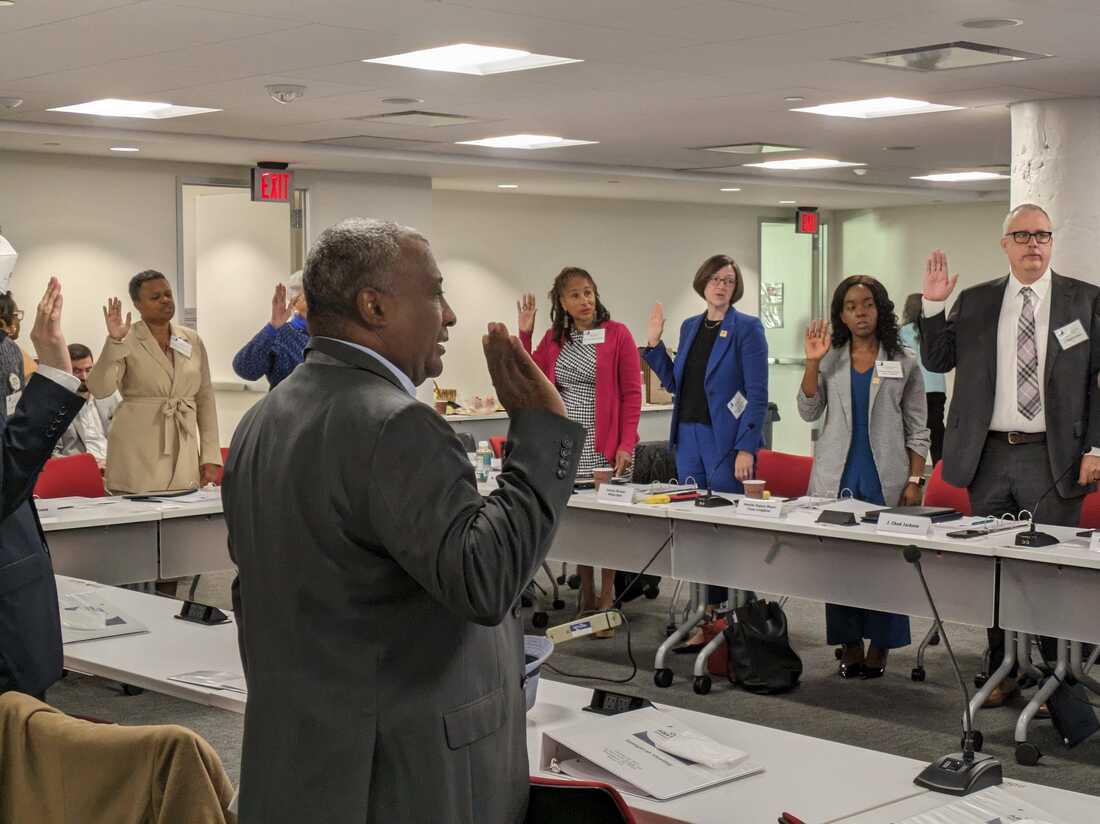
Members of the Washington, D.C., Opioid Abatement Advisory Commission, which will advise on the use of more than $80 million, met for the first time and were sworn in on Oct. 25, 2023. Like many other jurisdictions, the District of Columbia has yet to spend any of its settlement funds. Aneri Pattani/KFF Health News hide caption
toggle caption
Aneri Pattani/KFF Health News
Members of the Washington, D.C., Opioid Abatement Advisory Commission, which will advise on the use of more than $80 million, met for the first time and were sworn in on Oct. 25, 2023. Like many other jurisdictions, the District of Columbia has yet to spend any of its settlement funds.
Aneri Pattani/KFF Health News
5. Many places haven’t decided what to do with the money yet
Several states, including Montana and Hawaii, have yet to spend any of the settlement funds controlled by their state agencies. In Maine and West Virginia, councils overseeing the lion’s share of funds are still in the process of identifying priorities and developing processes to award grants.
Across the nation, some county officials say they need more guidance on appropriate uses of the money. Others are surveying residents on what they want before making decisions.
The slow pace has frustrated some advocates, who say there should be greater urgency at a time when the drug supply is becoming increasingly deadly. But others say the money will continue arriving through 2038, so setting up thoughtful processes now could pay off for years to come.
It’s a trade-off between putting out current fires and preventing future ones, said Shelly Weizman, project director of the addiction and public policy initiative at Georgetown University’s O’Neill Institute. She’s hopeful officials will strike the right balance.
“Is there a vision in each state about where we’re going to be when the settlement monies are done?” she said. “My hope is that 18 years from now we’re not still where we are today.”
KFF Health News, formerly known as Kaiser Health News (KHN), is a national newsroom that produces in-depth journalism about health issues and is one of the core operating programs at KFF — the independent source for health policy research, polling, and journalism.
Share this Post
