 Enlarge this image
Paramedic Larrecsa Cox (center) and her quick-response team, including police Officer Stephanie Coffey (left) and Pastor Virgil Johnson (right), check in at the home in Huntington, W.Va., of someone who was revived a few days before from an overdose. Sarah McCammon/NPR hide caption
toggle caption
Sarah McCammon/NPR
Paramedic Larrecsa Cox (center) and her quick-response team, including police Officer Stephanie Coffey (left) and Pastor Virgil Johnson (right), check in at the home in Huntington, W.Va., of someone who was revived a few days before from an overdose.
Sarah McCammon/NPR
Larrecsa Cox is a paramedic, but instead of an ambulance with flashing lights and sirens, she drives around in an old, white sedan.
Her first call on a recent day in Huntington, W.Va, was to a quiet, middle-class neighborhood.
“He overdosed yesterday,” Cox says. “And I think we’ve been here before. I’m almost 100 percent sure we’ve been to this house before.”
Cox is the only full-time member of Huntington’s new quick-response team — a collaborative project involving law enforcement, the county’s medical first responders and several drug treatment providers.
Shots – Health News
What To Make Of A Head-To-Head Test Of Addiction Treatments
The goal in this community ravaged by the opioid epidemic is simple: Track down people who’ve recently survived drug overdoses; visit them at home, a hospital or even in jail; and tell them how to get help.
Many rural Americans say drug addiction and abuse is the most urgent health problem facing their local community, according to a new poll by NPR, the Robert Wood Johnson Foundation and the Harvard T.H. Chan School of Public Health. The issue is particularly acute in Appalachia, our poll finds; 41 percent of people there called it the “biggest problem” facing their community, compared with 21 percent who said economic concerns were the biggest problem.
Loading…
(Don’t see the graphics above? Click here.)
Cox never knows quite what to expect on these house calls. Flanked by a police officer in plain clothes and a local pastor who’s volunteering with the team, she knocks at the door and waits. When there’s no response, she tries calling a family member whose phone number is in her files. Still no luck. The team eventually moves on, promising to come back another time.
At the next stop, trash is piled high on a curb outside what looks like an old storefront; it’s now a makeshift residence. Cox warns that the place is filthy inside.
She has visited several people at this home, only one of whom entered treatment.
“A lot of people seem to hang out here,” Cox says. “I really don’t know what to say about it.”
The narrow alleyway along the building smells of urine. It leads to a back porch strewn with pieces of trash. A sleeping man is slumped in a chair.
Through an open door on the side, we see in the darkened room a stained mattress piled with bedding.
Cox calls out to a man inside: “Is David here?”
He says something I can’t quite hear.
“What about Mary? Has Mary been back?”
Enlarge this image
Cox is the only full-time member of the quick-response team. A drug user’s turnaround is rarely quick, she finds, but still she returns with offers of help. It seems to be working. Overdose calls are down by about a third since the teams began making visits last year. Sarah McCammon/NPR hide caption
toggle caption
Sarah McCammon/NPR
Cox is the only full-time member of the quick-response team. A drug user’s turnaround is rarely quick, she finds, but still she returns with offers of help. It seems to be working. Overdose calls are down by about a third since the teams began making visits last year.
Sarah McCammon/NPR
“I ain’t seen Mary in three months,” the man inside says.
Cox leaves behind a card with information on how she can be contacted, then heads back to the car.
These bleak interactions are part of the quick-response team’s process, says Connie Priddy, a registered nurse with Cabell County Emergency Medical Services. She says it can take time to convince people who have overdosed that they need help.
“Overdosing and having to be revived may not be the bottom for someone,” Priddy says.
Priddy coordinates the quick-response teams, which got off the ground late last year with about $1.2 million from two federal grants. Community leaders were looking for solutions, she says, after more than two dozen people overdosed on a single day in August 2016. They modeled the teams after a similar program in Ohio.
The teams visit patients, provide information about clean needle programs, hand out supplies for stopping overdoses and, if at all possible, provide information on enrolling in treatment programs. Some patients ask about residential programs, while an increasing number are opting for outpatient, medication-assisted treatment that allows them to continue working or going to school.
“We leave them our information. We’ll go back a couple of days later and talk to them again,” Priddy says. “We’ll call them; we’ll text them. So if they’re not ready, they’re not ready — but we keep going back.”
That follow-up after an overdose is a key step in helping people finally get into treatment, says Dr. Alexander Walley, an internist and associate professor at Boston University School of Medicine and the director of an addiction medicine fellowship at Boston Medical Center. He says programs similar to Huntington’s are popping up in other communities.
Walley sees relying on such teams as a promising, if challenging, approach.
“If you’ve just overdosed a day or two ago, and now you have a police officer knocking on your door, that first inclination among a marginalized, stigmatized population might not be so welcoming,” Walley says. “And so how exactly to make that contact, I think, is really important.”
Enlarge this image
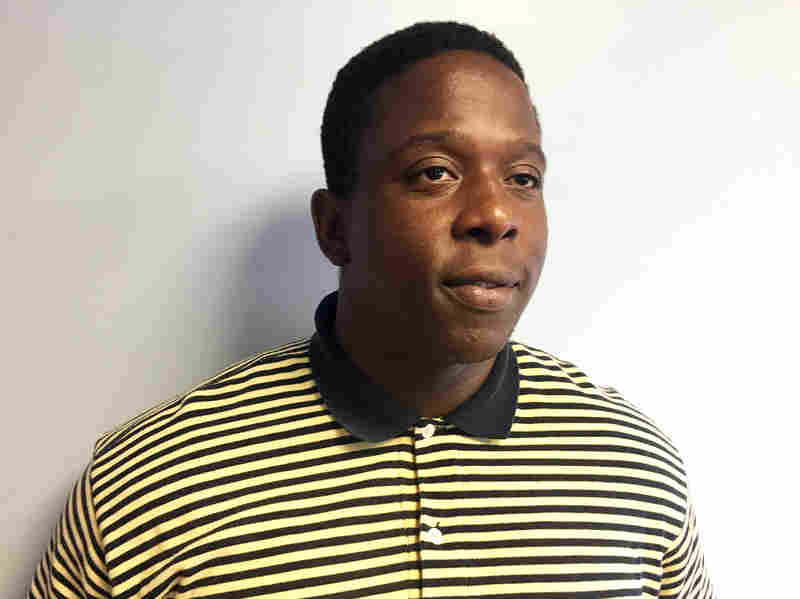
Anthony Dooley, 32, successfully graduated from an addiction recovery program recently. He credits Cox’s team with visiting him in the hospital and walking him through his options. Sarah McCammon/NPR hide caption
toggle caption
Sarah McCammon/NPR
Anthony Dooley, 32, successfully graduated from an addiction recovery program recently. He credits Cox’s team with visiting him in the hospital and walking him through his options.
Sarah McCammon/NPR
Police officers on Huntington’s quick-response teams wear civilian clothing and are under instructions not to make arrests unless children are at risk.
The program boasts some success stories, like Anthony Dooley, whom Cox calls its “poster child.” Dooley had struggled with drugs including alcohol, cocaine and crystal meth and had spent some time in jail before winding up in a hospital earlier this year.
“It was a point in my life to where I was lost; felt hopeless,” Dooley says. “I felt that, pretty much, where I was in life was the best that I was ever going to get.”
Dooley, 32, recently graduated from an inpatient addiction treatment program in Huntington. He says Cox’s team visited him in the hospital and walked him through his options.
“I was just so far gone,” Dooley says. “I was sleeping on the hospital bed. … She sat there with me the whole time, made sure the paperwork was done, and got me some help.”
Officials in Huntington are optimistic that the quick-response teams are beginning to push back on some of the effects of the opioid epidemic. Overdose calls in the area are down by about a third since the teams began making visits last year.
Community leaders say they’re now beginning to talk about how to fund the program after the grants run out in 2020.
Share this Post
