 Enlarge this image
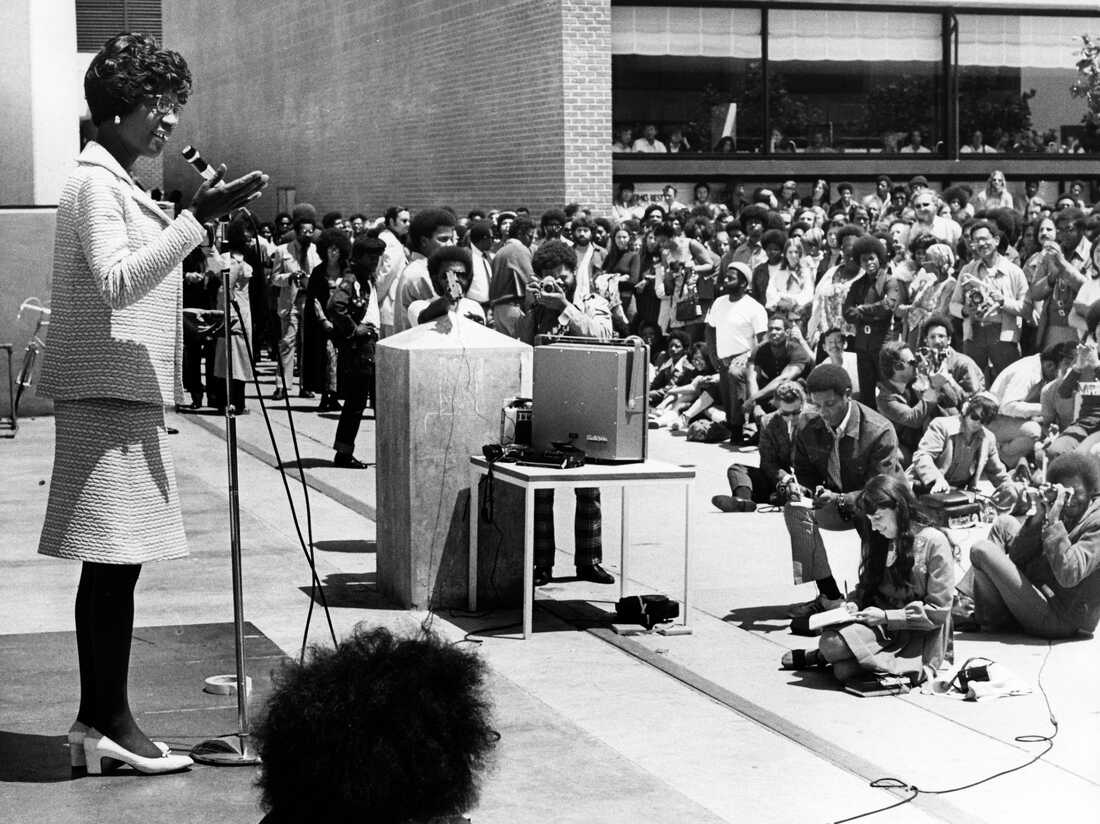
Shirley Chisholm, the first Black woman elected to U.S. Congress was running for president in 1972 when she had a remarkable interaction with the pro-segregation George Wallace, then governor of Alabama. Her efforts to build bridges with him ultimately changed his point of view. She’s pictured here giving a speech at Laney Community College during her presidential campaign. Howard Erker/Oakland Tribune-MediaNews Group via Getty Images hide caption
toggle caption
Howard Erker/Oakland Tribune-MediaNews Group via Getty Images
Shirley Chisholm, the first Black woman elected to U.S. Congress was running for president in 1972 when she had a remarkable interaction with the pro-segregation George Wallace, then governor of Alabama. Her efforts to build bridges with him ultimately changed his point of view. She’s pictured here giving a speech at Laney Community College during her presidential campaign.
Howard Erker/Oakland Tribune-MediaNews Group via Getty Images
Deeply entrenched conflicts are dividing the world – and many people’s social circles.
The violence in Israel and Gaza is triggering often overheated discussions among friends, family and strangers. This comes on top of other, increasingly sharp, rifts in the U.S., including fights over gun control, policing, abortion and other social and political issues.
Scientists who study the intersection of conflict and human behavior say it’s essential to understand the biology behind some of these toxic interactions. Becoming aware of our ingrained impulses, they say, can help us learn to diffuse combustible situations.
And some rare, but noteworthy people who have mastered this lesson — including Nelson Mandela and U.S. Congresswoman Shirley Chisholm — have changed history.
Middle East crisis — explained
The space for peace and Jewish-Arab solidarity is shrinking in wartime Israel
Understanding a hard-wired response
As social beings, humans are wired to forge strong bonds with groups that could help us survive against outside threats, research shows. It’s a natural evolutionary impulse.
Olga Klimecki, a neurology researcher and lecturer at the University of Jena in Germany, says brain scans show how powerfully social identity can shape our emotional response to situations.
For example, if someone sees a comrade in pain — a fellow member of one’s group — the brain will react with empathy. “My brain would simulate the suffering of the other person by reactivating how I feel when I am feeling bad,” Klimecki explains.
But, instead, if it is an adversary experiencing pain, not only is the same empathetic region of the brain not as active, she says, “we also sometimes see more activation related to schadenfreude or malicious joy.”
We empathize, in other words, based on our social affiliations, which might be based on race, ethnicity, religion or politics.
And that’s not all; conflict literally dampens our brain’s ability to feel love. Klimecki says studies show couples who just argued have less activity in regions of the brain that sense attachment and fondness.
Middle East crisis — explained
For some Jewish peace activists, demands for a cease-fire come at a personal cost
Lessons from peacemakers
So what to do about it?
Tim Phillips, a veteran conflict-resolution expert, helped negotiate some of the most fraught conflicts in modern history — ceasefires of religious clashes in Northern Ireland and the establishment of what became South Africa’s Truth and Reconciliation Commission after apartheid.
He says he’s seen how these evolutionary impulses shape how we fight with those around us, as well as on the world stage.
Phillips is not a neuroscientist, but says decades of peace-building made him appreciate how political stability and peace sometimes depend on the ability of individual leaders to understand and rise above some of that biology.
“Unfortunately, when we ignore how our brains actually work, then we’re increasingly finding ourselves in the situation that we increasingly find ourselves in,” Phillips says, “which is that we’re throwing bad approaches after bad approaches.”
Conflict deepens and escalates quickly, Phillips says, when we feel it threatening things we hold dearest — our sacred values — our social identity, or our people. We dig in deeper, become less rational. When fanned or exploited, such sentiments can override our sense of morality, and morph into hate and dehumanization, which make atrocities possible.
From apartheid to U.S. race relations
Defusing an escalating situation, therefore, first requires releasing a brain hijacked by defensive emotion. Phillips says it means saying to your opponent, for example: “I understand how important this is to you; I understand this is core to your identity and your community, and I respect your sacred values.”
It means reflecting your opponent’s humanity back to them. A similar approach, he says, can help reduce toxic polarization. It’s effective because in the heat of argument, people tend to demonize one another; counteracting that can neutralize assumptions of negative intent.
Phillips says he’s seen people emotionally disarm the opposition in a disagreement simply by recognizing their humanity. It can bring together fierce adversaries, and change history.
He cites Nelson Mandela in 1990, emerging from 27 years of political imprisonment to call South African president F.W. de Klerk — one of his captors — an “honorable man.”
At the time, the world was rallying behind Mandela, and vilifying de Klerk. So Phillips says Mandela calling him “honorable” had a huge impact on de Klerk.
“Without thinking about it rationally, he was probably deeply surprised. But Mandela just gave him a bridge,” he says.
The two men went on to work together to end apartheid.
He cites a lesser-known example from 1972: Shirley Chisholm, the first Black congresswoman in the U.S., was battling for the Democratic presidential nomination with political rival Alabama Governor George Wallace, a fierce segregationist.
After he was shot in an attempted assassination, Chisholm visited him in the hospital and prayed at his bedside for his recovery.
“Wallace’s daughter later said that that gesture of compassion completely changed her father,” Phillips says. Wallace reportedly wept openly, and shifted his stance on racial segregation.
Middle East
Peace activists in Israel speak about their hopes for the end of war
How to talk with friends and family
Phillips says these approaches can work on a smaller scale too. Recently, Phillips says he used them to repair a long-time friendship damaged by sharp political differences. Philips offered an olive branch by voicing respect for his friend’s viewpoint, and appreciation for the social background that led him there.
Within days, the friend returned, saying Phillips’ understanding prompted him to rethink his own hardline views.
“He literally said, ‘I felt like I could breathe and our relationship again, and I started to change my mind,'” Phillips recalls. His friend admitted he didn’t agree with a lot of the platforms his party supported, even though Phillips wasn’t trying to sell him on policy.
He and his friend still might not agree on many things, he says, but at least they can still talk.
If you’re in a particularly heated argument, Klimecki, the neurologist, suggests taking “microbreaks” to help regain perspective. She also suggests taking measures to reduce stress – because stress reduces function in a part of the brain that helps us think rationally.
“The more chronic stress we have, the less our prefrontal cortex is functioning,” she says.
So, she advises getting more sleep, trying deep breathing or thinking of something that makes you feel positive. All these can cut down stress and give you greater capacity to handle conflict better — and hopefully keep dialogue open with your friends and loved ones, even when you disagree.
Carmel Wroth edited this story.
Share this Post
