 Enlarge this image
People who practice cognitively enhanced tai chi significantly improved their scores on memory tests. PYMCA/Avalon via Getty Images hide caption
toggle caption
PYMCA/Avalon via Getty Images
People who practice cognitively enhanced tai chi significantly improved their scores on memory tests.
PYMCA/Avalon via Getty Images
Your keys aren’t in the spot you thought you left them? Can’t recall the title of a book? I’ve had those moments.
Amid our busy lives, distraction or fatigue may explain our forgetfulness. But instances of “brain freeze” make me realize I want to do everything in my power to keep my brain sharp.
There’s plenty of evidence that exercise can help protect our bodies and brains. And as we age, daily movement doesn’t need to be super intense. In fact, a new study finds tai chi, a slow-moving form of martial arts, can help slow cognitive decline and protect against dementia.
The study included about 300 older adults, in their mid-70s on average, who had all reported that their memory was not as good as it used to be.
As part of the study, all the participants took a 10-minute test, called the Montreal Cognitive Assessment, to gauge cognitive function. A normal score is 26-30. A person who scores between 18 and 25 is considered to have mild impairment, which means they don’t have dementia but they’re not as sharp as they used to be and may need to work harder to maintain everyday activities. The average score of participants at the start of the study was 25.
Enlarge this image
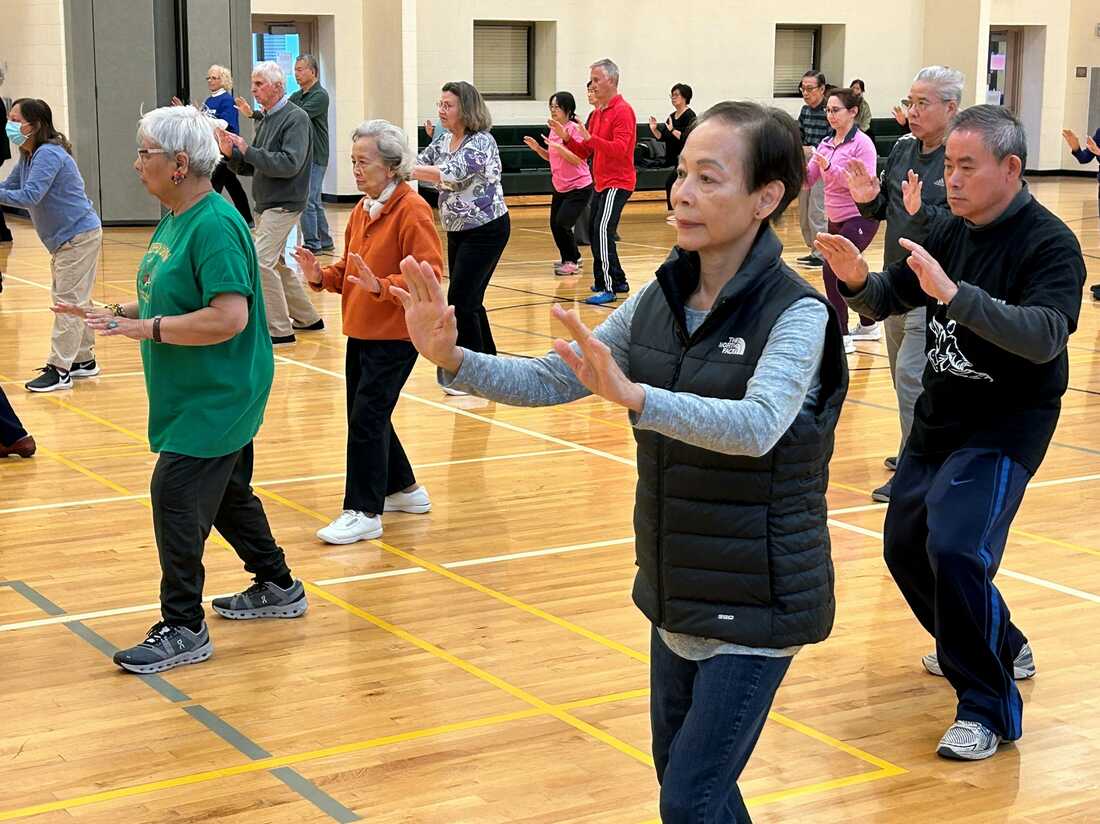
A tai chi class held at the North Potomac Community Rec Center in Potomac, Md. Tai chi has been shown to improve balance, prevent falls and help slow down cognitive decline. Allison Aubrey/NPR hide caption
toggle caption
Allison Aubrey/NPR
A tai chi class held at the North Potomac Community Rec Center in Potomac, Md. Tai chi has been shown to improve balance, prevent falls and help slow down cognitive decline.
Allison Aubrey/NPR
The study found that people who practiced a simplified form of tai chi called Tai Ji Quan twice a week for about six months improved their score by 1.5 points. This increase may not sound like a lot, but study author Dr. Elizabeth Eckstrom says “you’ve basically given yourself three extra years” of staving off decline. The study is published in Annals of Internal Medicine.
A person with mild cognitive decline can expect to lose, on average, about a half point each year on the test, and once their score drops under 18, people experience quite a bit of impairment from memory loss and cognitive decline, Eckstrom explains.
So, based on these results, “if you’re able to keep doing [tai chi] two or three days a week on a routine basis, you’re going to get extra years before you hit that decline into dementia,” she says.
Eckstrom and her collaborators also tested a more rigorous type of tai chi, called Cognitively Enhanced Tai Ji Quan, where they layered on extra challenges. For example, participants were asked to spell a word, backward and forward, as they moved through a series of tai chi moves.
“You’re really forcing your brain to think hard while you’re also doing the fluid mind-body movements,” Eckstrom explains.
The people who practice this type of cognitively enhanced tai chi improved their scores by about 3 points. “We’ve just given you six extra years of cognitive function,” she says. “That’s a lot.”
Her theory on why tai chi is effective is that it combines the memorization of the movements, known as forms, almost like a dance choreography. “So, you’re getting the physical activity, plus the memory piece,” she says.
Shots – Health News
Can multivitamins improve memory? A new study shows ‘intriguing’ results
Dr. Joseph Quinn, a neurologist at Oregon Health & Science University, who was not involved in the study, says the results fit with a body of evidence, including a meta-analysis, showing the benefits of tai chi. “This has fascinated me,” Quinn says, because the results are impressive, but “honestly, I don’t understand why it works so well.”
The benefits of cardiovascular workouts, which help protect the heart and the brain, are better understood, he says. But tai chi isn’t much of an aerobic workout, so he says perhaps the meditative component has a stress reduction effect that helps explain the other benefits.
“It becomes a meditative practice,” says Mary Beth Van Cleave, 86, who lives in a retirement community with her wife and their cat in the Portland, Ore., area. She started tai chi at age 75 and says her practice helps her feel grounded and enables her to let go of stress. “It’s become an important part of my life,” Van Cleave says.
In terms of a cognitive boost, she thinks tai chi helps with concentration. “I’m more conscious of trying to do one thing at a time,” she says.
One limitation of the study is that most of the participants were non-Hispanic white and about two-thirds had college degrees. It’s hard to know whether the benefits would hold up for the broader population. A study published last year found there’s a disproportionate burden of cognitive impairment and dementia among Black and Hispanic populations in the U.S., and among people with less education. Researchers say they’d like to see efforts to make tai chi more accessible given the benefits, and given that by age 65, about 1 in 5 people has mild cognitive impairment.
If you’ve never done tai chi, which is a martial art that incorporates a series of movements, known as forms, with a focus on controlled breathing, too, it may look like nothing much is happening. But that’s a misconception, Van Cleave says. “We are working very hard, ” she explains. And, she says, the physical benefits are pronounced.
“There are so many times I’ve avoided a fall,” she says. “That’s because of the balance that tai chi gives me.”
Many studies have shown that practicing tai chi can help prevent falls and improve balance in older adults, and the benefit is greatest for people who keep up a regular practice over time.
Shots – Health News
7 habits to live a healthier life, inspired by the world’s longest-lived communities
This story was edited by Jane Greenhalgh
Share this Post
