 Enlarge this image
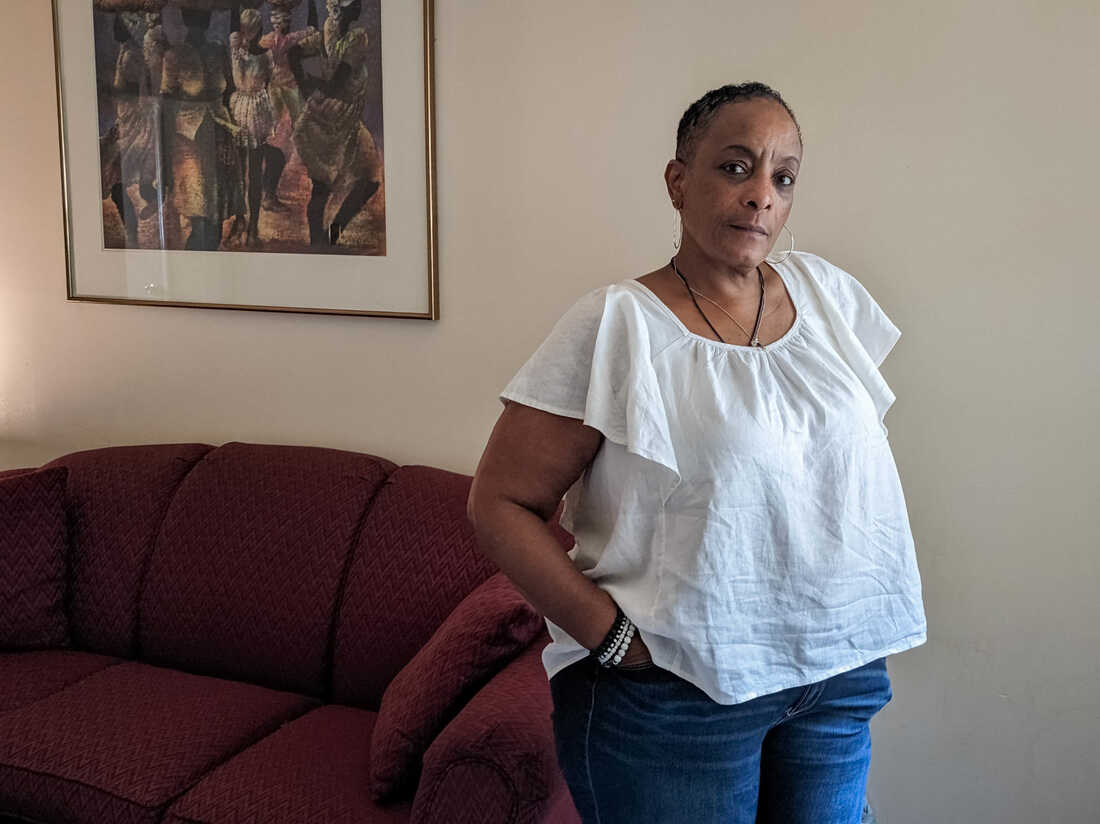
Penelope Wingard of Charlotte, N.C., has survived breast cancer, a brain aneurysm and surgery on both eyes. For the past eight years, she’s also been battling tens of thousands of dollars in medical debt. Aneri Pattani/ KHN hide caption
toggle caption
Aneri Pattani/ KHN
Penelope Wingard of Charlotte, N.C., has survived breast cancer, a brain aneurysm and surgery on both eyes. For the past eight years, she’s also been battling tens of thousands of dollars in medical debt.
Aneri Pattani/ KHN
After a year of chemotherapy and radiation, doctors told Penelope Wingard in 2014 that her breast cancer was in remission. She’d been praying for this good news. But it also meant she no longer qualified for a program in North Carolina that offers temporary Medicaid coverage to patients undergoing active breast cancer treatment.
Wingard became uninsured. She’d survived the medical toll, but the financial toll was ongoing.
Bills for follow-up appointments, blood tests and scans quickly piled up. Soon, her oncologist said he wouldn’t see her until she paid down the debt.
Shots – Health News
Medical debt upended their lives. Here’s what it took from them
“My hair hadn’t even grown back from chemo,” Wingard says, “and I couldn’t see my oncologist.”
Medical debt has sunk her credit score so low that she has struggled to qualify for loans, and applying for jobs and apartments has become a harrowing experience.
“It’s like you’re being punished for being sick,” Wingard says.
Earlier this year, when three national credit agencies announced new policies to deal with medical debt, consumer advocates celebrated, thinking it would provide relief for patients like Wingard. But it turns out the changes aren’t enough to help her or many other Black and low-income patients, who are often the ones hit hardest by medical debt.
“They’re just removing the small stuff”
Under the new policies, Equifax, Experian and TransUnion will remove from credit reports any paid debts or individual bills that were less than $500 and had gone to collections, even if unpaid. This doesn’t wipe out what people owe, but the idea is to remove the black mark of collections from their credit so they can more easily reach milestones like qualifying for a car or home loan.
The changes, which go into full effect in 2023, are expected to benefit an estimated 16 million Americans. But a federal report released this summer suggests those may not be the people who need it most.
“Although the credit reporting companies have trumpeted this as a big change, the fact is they’re just removing the small stuff,” says Ryan Sandler, a co-author of the report and senior economist with the Consumer Financial Protection Bureau. “They’re not maybe doing as good of a thing as their press releases would like you to believe.”
Medical debt is highest in Southern states that didn’t expand Medicaid
People burdened most by medical debt tend to be Black or Hispanic, low-income, and in the South. A nationwide KFF poll found 56% of Black adults and 50% of Hispanic adults say they have current debt due to medical or dental bills, compared with 37% of non-Hispanic white adults. And a study published in 2021 found medical debt was highest within low-income communities and in Southern states that had not expanded Medicaid.
Shots – Health News
State Border Splits Neighbors Into Medicaid Haves And Have-Nots
Shots – Health News
This group’s wiped out $6.7 billion in medical debt, and it’s just getting started
But, Sandler says, “the population that is going to have all their collections removed is a little more likely to live in majority-white neighborhoods and high-income neighborhoods.”
Collections under $500 often result from an unpaid copay or coinsurance, Sandler says, and people with insurance are more likely to be richer and white.
Someone like Wingard — a Black woman living in North Carolina — is less likely to benefit from the credit companies’ new policies.
After Wingard’s oncologist cut her off, it took almost six months to find another doctor who would see her while letting bills go unpaid.
North Carolina has not expanded Medicaid, so despite her low income, Wingard, who is 58 and does not have young children, doesn’t qualify for the public insurance program in her state.
She estimates her total medical debt today is over $50,000. It’s not just for cancer care, but also bills for unrelated health problems that developed in the following years.
She has worked as an after-school teacher and tutor, a COVID-19 contact tracer and a driver for a ride-hailing service, but none of those jobs has come with health insurance benefits. Wingard says she tried to buy private insurance on the marketplace several years ago, but her monthly premium would have been more than $200, which she can’t afford.
That left her on the hook for bill after bill after bill. Her credit report shows five pages of notifications from collection agencies representing doctor’s offices, hospitals and labs.
Nearly 20% with medical debt fear they’ll never pay it off
Wingard is resourceful. She has hunted down clinics that work on sliding-scale fees, pharmacy programs that reduce copays and nonprofits that help cover health care costs. But it has not been enough to dig her out of debt.
In February, Wingard needed a specialized mammogram to check for cancer recurrence. Ahead of the appointment, she contacted a local nonprofit that agreed to cover the cost. But a few weeks after the procedure, Wingard received a bill for nearly $1,900. There was some miscommunication between the nonprofit and the hospital, Wingard says. While she tried to resolve the issue, the bill went to collections. It’s more than $500, so it won’t be removed even when the new credit agency policies take full effect next year.
Shots – Health News
Some hospitals rake in high profits while their patients are loaded with medical debt
“You fight so hard and you go through so much,” Wingard says. “Still, sometimes you don’t see any kind of relief.”
Nearly 20% of Americans with medical debt don’t think they’ll ever pay it all off, according to the KFF poll. Wingard has resigned herself to living with the ramifications.
“It makes you feel worthless, like you can’t do anything”
Her fridge and stove have both been broken for more than a year. She can’t qualify for a loan to replace them, so instead of making baked chicken from her favorite family recipe, she often settles for a can of soup or fast-food chicken wings instead.
In emergencies — such as when she needed to repair a broken tooth this fall — Wingard borrows from family. But it’s not easy to ask for money, she says. “It makes you feel worthless, like you can’t do anything.”
A study published recently found that medical debt leaves many people unable to pay for basic utilities, increases their housing and food insecurity, and can “contribute to a downward spiral of ill-health and financial precarity.”
How bad credit reports hurt job prospects
For Wingard, it has hurt her ability to get a job. She says two employers told her that poor credit shows up as a red flag on background checks and has led her to be turned down for positions.
Employers sometimes use credit reports as a “proxy on character,” explained Mark Rukavina, a program director with the nonprofit health advocacy group Community Catalyst. If two candidates are equally qualified but one has low credit or several unpaid debts, employers might consider that person less responsible, he says — despite research showing medical debt is not an accurate predictor of someone’s likelihood to pay bills.
Although the new policies from credit companies are unlikely to improve Wingard’s situation, consumer advocates say there are signs that society is starting to think about medical debt differently.
The Biden administration has advised federal lenders to no longer consider medical debt when evaluating loan applications and has asked the Consumer Financial Protection Bureau to investigate whether medical debt should ever appear on credit reports.
A federal law banning certain types of surprise medical bills went into effect this year, and some states have strengthened protections against medical debt by expanding Medicaid or holding nonprofit hospitals accountable for providing financial assistance to low-income patients.
In August, VantageScore, a company that calculates credit scores, said it will stop using medical collections in its formula.
Wingard is ready for swifter and stronger change. And she has an idea for how to get there: a march on Washington to demand relief from medical debt and universal insurance to reduce future bills.
“For a million people to gather up there and say we need better health care, I think that’d be history-making,” she says. “Maybe then they’ll recognize we need help.”
KHN (Kaiser Health News) is an editorially independent, national program of KFF (Kaiser Family Foundation).
Share this Post
