 Enlarge this image
Maria Fabrizio/NPR
I used to flinch at the topic of aging. Is there anything we can do about the inevitable?
But recently I’ve been digging into a new wave of longevity research that is making it an exciting time to be an aging human — which is all of us.
It turns out, we all age at varying rates. Super-agers may have great genes, but research shows our habits and routines — everything from what we eat and how we move our bodies to who we spend our time with — matter a lot, when it comes to aging well.
Now, the next frontier is to target the basic biology of aging and come up with new interventions to slow it down.
Many scientists are optimistic that we’re on the cusp of breakthroughs. Not only to help us live longer, but — more importantly — to extend the number of years we live with good health.
This is the goal of researchers at the Human Longevity Lab at the Northwestern University Feinberg School of Medicine. They’re recruiting study participants so they can test what kinds of interventions may slow the rate of aging. To that end, I decided to roll up my sleeve for science.
Welcome to aging: My visit to the longevity lab
When I arrived, the first step was a quick blood draw. The Potocsnak Longevity Institute is housed on the light-filled 21st floor of Northwestern Memorial Hospital, overlooking Lake Michigan. It felt more like a spa than a doctor’s office. I didn’t anticipate the vast range of data and insights scientists could glean from a battery of tests.
Over a four-hour period, they performed more than two dozen assessments. At first it felt a bit like an annual physical. They checked my blood pressure, weight, glucose and cholesterol.
Enlarge this image
NPR’s Allison Aubrey has her body composition measured inside a BodPod. Several other tests performed at the longevity lab — led by Dr. Douglas Vaughan — are used to estimate biological age. Jane Greenhalgh/NPR hide caption
toggle caption
Jane Greenhalgh/NPR
NPR’s Allison Aubrey has her body composition measured inside a BodPod. Several other tests performed at the longevity lab — led by Dr. Douglas Vaughan — are used to estimate biological age.
Jane Greenhalgh/NPR
But then, the tests got a lot more interesting. Inside a small exam room, a medical assistant opened the hinge of a BodPod, a capsule that looks like a submersible. The machine assessed my body composition, determining the ratio of fatty mass to lean mass, which includes muscle. Strength is a key marker of healthy aging, helping us fend off frailty and falls.
Next, I was asked to sniff and identify a range of distinct smells — from leather to chocolate — to test olfactory function. The loss of smell can be an early sign of disease and cognitive decline. They scanned my retina and took digital images of the inside of my eyes, which can also help detect disease. And I took a memory and cognitive function test, called MOCA. Thankfully, all was healthy.
Then I went through a slew of cardiovascular health tests. They measured my endothelial function, which keeps blood flowing smoothly through the body. They looked at my heart rate variability and pulse-wave velocity, which is an indicator of stiffness of the arteries. I had electrodes placed onto my chest for an electrocardiogram.
Midway through I was feeling a bit nervous, and my mind raced to what ifs.
Of all the tests they performed, the most intriguing is the GrimAge test. This test predicts biological age. It’s gauging whether your DNA age is younger, or older, than your actual age, known as chronological age. Conjure images of the Grim Reaper? Yep, that’s the idea: The test can estimate how quickly, or slowly, you’re aging.
To figure this out, researchers use a technique based on DNA methylation, which is a measure of modifications in our DNA. Basically, as we age, compounds called methyl groups attach to some of our DNA molecules, which can turn genes on or off. Researchers have shown that the higher the proportion of methylated DNA in certain locations, the more accelerated a person’s biological age. Published research suggests this is a reliable way to predict life span and health span.
Can you change your biological age?
No one wants to find out they’re aging faster than their peers, right? But here’s the exciting part. Our biological age may be malleable. The hope is that we can slow down our rate of aging — by making changes to lifestyle. Down the line, there may be anti-aging pills or other interventions.
Enlarge this image
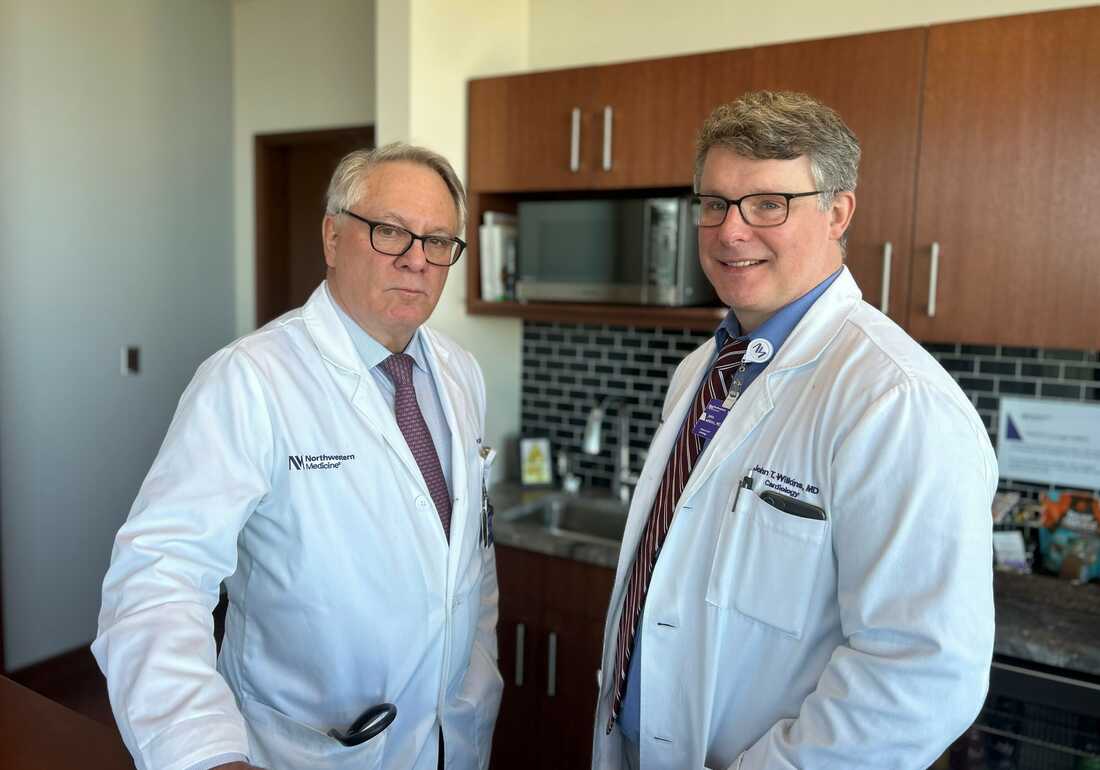
Dr. Douglas Vaughan and Dr. John Wilkins of the Northwestern University Feinberg School of Medicine and the Potocsnak Longevity Institute. Allison Aubrey/NPR hide caption
toggle caption
Allison Aubrey/NPR
Dr. Douglas Vaughan and Dr. John Wilkins of the Northwestern University Feinberg School of Medicine and the Potocsnak Longevity Institute.
Allison Aubrey/NPR
For researchers, the GrimAge test isn’t just a way to estimate DNA age. It’s a tool to study whether interventions can alter it.
“That’s the big ray of optimism that comes through all of this — the possibility that we can slow down aging and extend the health span of people,” says Dr. Douglas Vaughan, director of the Longevity Institute. Health span is the number of years we live with good health. “It can be changed very rapidly in experimental models and probably in people, too,” he says.
For example, smoking has a very strong effect on methylation. “Tens of thousands of locations gain methylation when you smoke,” explains researcher Steve Horvath, who developed the epigenetic clock used as part of the GrimAge test. People with obesity also exhibit higher methylation at certain locations. “Conversely, if you eat vegetables, if you are lean, if you exercise, that slows methylation age,” he explains.
Now, of course, it’s long been known that smoking and eating poorly are bad for you. But researchers can now test specific interventions to see if it’s possible to move the needle.
Vaughan’s deep interest in aging took off when he identified a distinct genetic variant in an Amish community in Indiana. People who have the variant are protected from diabetes and have healthier cardiovascular systems compared to people who don’t. In the laboratory, when Vaughan engineered mice to have only a 50% level of a protein associated with this mutation, their life spans increased by nearly fourfold. “This was a eureka moment,” he says.
He tells his current medical students that in their careers they will prescribe interventions to slow down biological aging in their patients.
“I don’t know exactly what that’s going to be. It might be a drug. It might be a lifestyle intervention, for all I know it might be gene editing,” Vaughan says. “But there are going to be ways that we are going to slow down this process and give people a longer health span.”
Democratizing aging
People who live in the upscale Chicago neighborhood where the Human Longevity Lab is located can expect to live a much longer, healthier life compared to people who live just a few miles away. Vaughan wants to help close this gap.
“I’m worried about the poor soul in south Chicago who has a life expectancy of 55, compared to 92 in the neighborhood where we’re standing right now,” he says. A stunning difference of more than 30 years. (You can check out life expectancy in your ZIP code here.)
Shots – Health News
7 habits to live a healthier life, inspired by the world’s longest-lived communities
A lot of factors play into this life expectancy gap including poverty, housing, stress and crime, which can all work against health span.
Vaughan and his collaborators are enrolling people from a wide range of ages, ethnic groups, neighborhoods and socioeconomic status to see what works to slow biological aging for everybody.
“There are lots of people who’ve been dealt a bad hand with regard to aging,” Vaughan says. Their goal is to find affordable, evidence-based interventions that can benefit everyone, regardless of socioeconomic status.
For example, there’s interest in studying stress, which Vaughan says could be “part of the reason for the discrepancy in the life expectancy in different neighborhoods of Chicago.” To study this, he could measure people’s biological age at baseline, have them try a stress-reduction program, and test again to see if their results changed.
Vaughan is also interested in studying people with chronic HIV, who tend to age at an accelerated rate. A charitable gift from a Chicago family with a shared interest helped launch the institute. Vaughan’s team is considering a range of interventions to test whether they can slow down aging in this population.
“It might be weight training, it might be intermittent fasting, it might be dietary manipulations, it might be drugs that are available now that might have anti-aging effects,” Vaughan explains, citing the diabetes drug metformin.
Shots – Health News
Tai chi helps boost memory, study finds. One type seems most beneficial
Longevity and health span research is attracting lots of funding and attention, from places like the Hevolution Foundation, which provides grants and early stage investments, and Altos Labs, a biotechnology company, founded by Dr. Rick Klausner, which is investigating ways to reprogram or rejuvenate cells.
Dozens of groups have signaled their intent to compete in the $101 million X-PRIZE global competition focused on treatments that support healthy longevity — everything from new drugs or supplements, to devices, to repurposing old drugs for new uses.
“Teams have to come to the starting line and we’re going to set up the frameworks by which they prove their therapeutic works,” says XPRIZE’s Jamie Justice, who is also a researcher at Wake Forest University School of Medicine.
Embracing aging science
Fortunately, my GrimAge score came back younger than my actual age, though I did get some surprises. I learned that my body composition isn’t optimal. Turns out, I need to build more lean muscle mass, which is pretty common as we age — especially for women.
With muscle mass, if you don’t use it, you lose it. After the age of 30 to 35, muscle starts to slowly decline. And after age 65 or so, this loss accelerates. So it’s never too soon to start building a reserve. My goal for this year is to build muscle through resistance training and an optimal diet. And also, to reduce stress.
My experience in the longevity study has motivated me to get started on a new project: How To Thrive As You Age. We’ll have more stories on healthy aging interventions coming soon.
Share your aging secrets
As part of this project, we hope you’ll share your healthy aging tips with us. What habits or lifestyle hacks have you’ve adopted to thrive as you age? Please use this form to share your thoughts or email us at Thrive@npr.org.
Share this Post
