 Enlarge this image
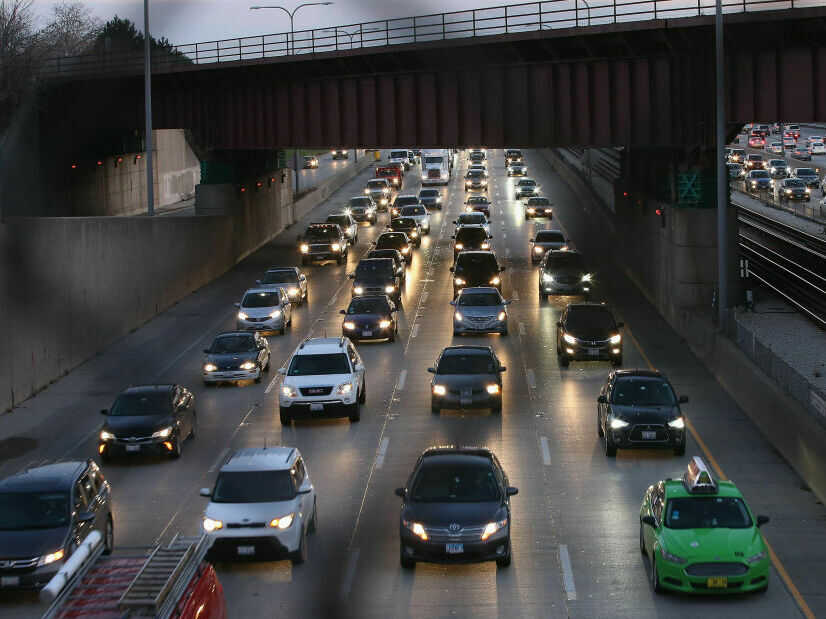
Commuting offers some workers a period of respite between work and home, researchers found. massimo colombo/Getty Images hide caption
toggle caption
massimo colombo/Getty Images
Commuting offers some workers a period of respite between work and home, researchers found.
massimo colombo/Getty Images
For most American workers who commute, the trip to and from the office takes nearly one full hour a day — 26 minutes each way on average, with 7.7% of workers spending two hours or more on the road.
Many people think of commuting as a chore and a waste of time. However, during the remote work surge resulting from the COVID-19 pandemic, several journalists curiously noted that people were — could it be? — missing their commutes. One woman told The Washington Post that even though she was working from home, she regularly sat in her car in the driveway at the end of the workday in an attempt to carve out some personal time and mark the transition from work to nonwork roles.
As management scholars who study the interface between people’s work and personal lives, we sought to understand what it was that people missed when their commutes suddenly disappeared.
This story comes from The Conversation, a nonprofit, independent news organization.
Commutes and liminal space
In our recently published conceptual study, we argue that commutes are a source of “liminal space” — a time free of both home and work roles that provides an opportunity to recover from work and mentally switch gears to home.
During the shift to remote work, many people lost this built-in support for these important daily processes. Without the ability to mentally shift gears, people experience role blurring, which can lead to stress. Without mentally disengaging from work, people can experience burnout.
We believe the loss of this space helps explain why many people missed their commutes.
In our study, we wanted to learn whether the commute provides that time and space, and what the effects are when it becomes unavailable.
We reviewed research on commuting, role transitions and work recovery to develop a model of a typical American worker’s commute liminal space. We focused our research on two cognitive processes: psychological detachment from the work role — mentally disengaging from the demands of work – and psychological recovery from work — rebuilding stores of mental energy used up during work.
Based on our review, we developed a model which shows that the liminal space created in the commute created opportunities for detachment and recovery.
Enlarge this image
American workers have long complained about commuting but during the pandemic when remote work was required for many, some people realized they missed their commute. Scott Olson/Getty Images hide caption
toggle caption
Scott Olson/Getty Images
American workers have long complained about commuting but during the pandemic when remote work was required for many, some people realized they missed their commute.
Scott Olson/Getty Images
How you commute makes a difference
However, we also found that day-to-day variations may affect whether this liminal space is accessible for detachment and recovery. For instance, train commuters must devote attention to selecting their route, monitoring arrivals or departures and ensuring they get off at the right stop, whereas car commuters must devote consistent attention to driving.
We found that, on the one hand, more attention to the act of commuting means less attention that could otherwise be put toward relaxing recovery activities like listening to music and podcasts. On the other hand, longer commutes might give people more time to detach and recover.
In an unpublished follow-up study we conducted ourselves, we examined a week of commutes of 80 university employees to test our conceptual model. The employees completed morning and evening surveys asking about the characteristics of their commutes, whether they “shut off” from work and relaxed during the commute and whether they felt emotionally exhausted when they got home.
Most of the workers in this study reported using the commute’s liminal space to both mentally transition from work to home roles and to start psychologically recovering from the demands of the workday. Our study also confirms that day-to-day variations in commutes predict the ability to do so.
We found that on days with longer-than-average commutes, people reported higher levels of psychological detachment from work and were more relaxed during the commute. However, on days when commutes were more stressful than usual, they reported less psychological detachment from work and less relaxation during the commute.
How remote workers can create a commute experience
Our findings suggest that remote workers may benefit from creating their own form of commute to provide liminal space for recovery and transition — such as a 15-minute walk to mark the beginning and end of the workday.
Our preliminary findings align with related research suggesting that those who have returned to the workplace might benefit from seeking to use their commute to relax as much as possible.
To help enhance work detachment and relaxation during the commute, commuters could try to avoid ruminating about the workday and instead focus on personally fulfilling uses of the commute time, such as listening to music or podcasts, or calling a friend. Other forms of commuting such as public transit or carpooling may also provide opportunities to socialize.
Our data shows that commute stress detracts from detachment and relaxation during the commute more than a shorter or longer commute. So some people may find it worth their time to take the “scenic route” home in order to avoid tense driving situations.
Matthew Piszczek researches human resources and is an assistant professor of management at Wayne State University. Kristie McAlpine researches the changing nature of work and is an assistant professor of management at Rutgers University.
This story comes from The Conversation, a nonprofit, independent news organization dedicated to unlocking the knowledge of experts for the public good.
Share this Post
