 Enlarge this image
Hugh Lampkin speaks with users inside a supervised injection room in Vancouver, British Columbia. Run by Vancouver Area Network of Drug Users (VANDU), it’s a place where peers help each use drugs safely. Rafal Gerszak for NPR hide caption
toggle caption
Rafal Gerszak for NPR
Hugh Lampkin speaks with users inside a supervised injection room in Vancouver, British Columbia. Run by Vancouver Area Network of Drug Users (VANDU), it’s a place where peers help each use drugs safely.
Rafal Gerszak for NPR
People who use injection drugs in Vancouver, British Columbia, can do so, if they choose, under the watchful eyes of someone trained to help them if they overdose.
This is the idea behind supervised injection sites, and it’s an approach that over a dozen U.S. cities or states are considering to prevent drug overdose deaths and the spread of disease.
Public health authorities in Vancouver, Canada, have run a supervised drug use center, Insite, since 2003. And as the death toll reaches record levels — 1,422 people died of overdose in British Columbia in 2017 — new grassroots sites are popping up, run not by doctors and nurses, but by drug users themselves.
The injection room
In a storefront in Vancouver’s Downtown Eastside neighborhood, drug users can find the Vancouver Area Network of Drug Users or VANDU, as it’s known.
Just inside the front door sits a virtual salad bar of drug supplies — clean needles, candles, sanitizer pads. People lounge on mismatched couches, napping or huddled in conversation. Posters on the walls pay tribute to members of the community who have succumbed to overdose.
Another poster shows a hand-drawn body with the safest places to inject colored in green and riskier body parts in red.
The site has literature available on treatment options which supervisors will share when people ask.
Enlarge this image
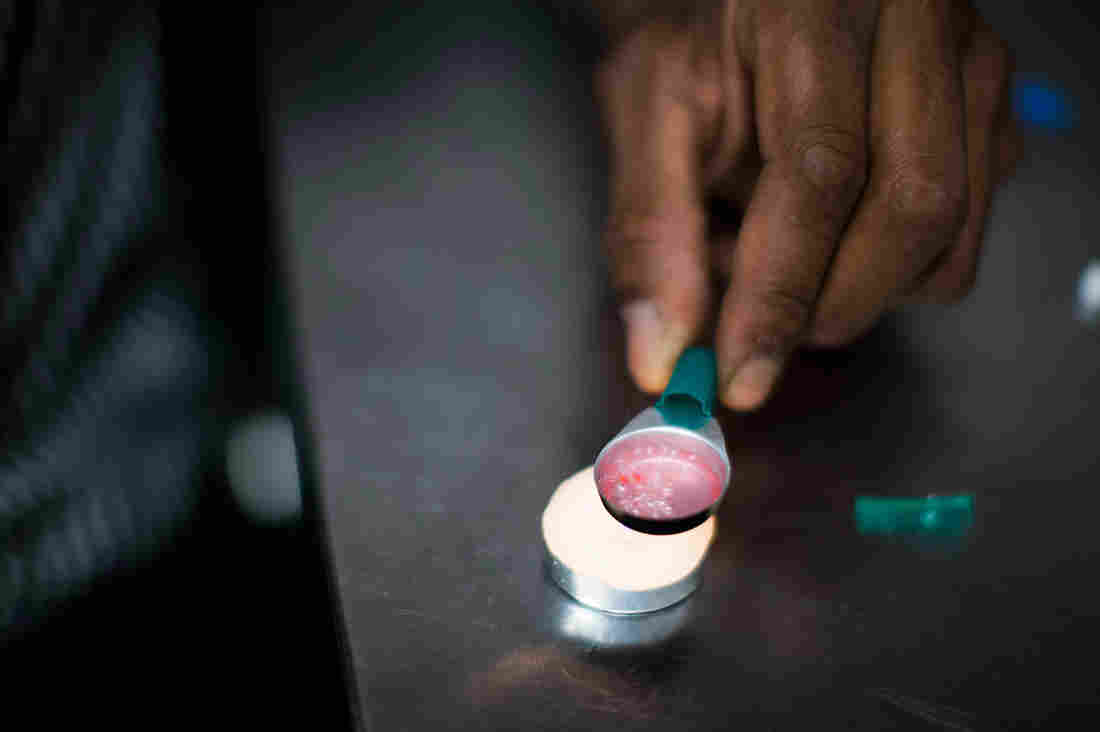
A drug user prepares to inject himself with heroin inside VANDU’s supervised injection room. Rafal Gerszak for NPR hide caption
toggle caption
Rafal Gerszak for NPR
A drug user prepares to inject himself with heroin inside VANDU’s supervised injection room.
Rafal Gerszak for NPR
Down a short hall in the back, there’s a small room with a wide glass window, a few tables and half a dozen chairs.
“This is the injection room we have,” says Hugh Lampkin, a supervisor at this site and vice president of VANDU.
Lampkin explains how a trained attendant keeps watch as people use drugs and administers an antidote if somebody overdoses.
As he talks, a wiry man with a black goatee pops his head out of the injection room. The attendant hands him a large mirror.
“One of the big things is, they call it ‘jugging.’ After a while it’s really hard to find veins on your legs or your arm. So you have your jugular at your throat,” Lampkin says.
This is an especially dangerous practice. The user could easily hit an artery and cause a stroke.
“We try and discourage it, but if they’re set on it, why not give them the education to do it properly,” Lampkin says.
Why help someone do something so risky? Staff here say people would be doing it anyway, with fewer precautions. That’s the idea behind harm reduction, a philosophy of meeting drug users where they are to try to minimize negative consequences of drug use, which often means helping them stay alive.
Enlarge this image
Hugh Lampkin, left, watches over the supervised injection room inside VANDU in Vancouver’s Downtown Eastside, British Columbia. Rafal Gerszak for NPR hide caption
toggle caption
Rafal Gerszak for NPR
Hugh Lampkin, left, watches over the supervised injection room inside VANDU in Vancouver’s Downtown Eastside, British Columbia.
Rafal Gerszak for NPR
In this case, it means teaching the heroin user to watch what he’s doing.
The wiry man props the mirror up on a chair, sinks to all fours, and examines his throat closely. Moments later, with the attendant watching through glass, he slips the needle in.
Run by users
Lampkin got involved with VANDU at a particularly low point of his own struggles with addiction. He has been a heroin user off and on for most of his life. At the time, VANDU was primarily an advocacy organization for drug users that hosted meetings and support groups. He joined a meeting there one day.
“I was telling a bunch of strangers my life story, and it was something I’d never done before,” he recalls. “After that just about everybody came up and either hugged me or shook my hand.”
He says finding that support was transformative.
“It was like you’re in a dish, and the glass comes off the dish, and I could actually see and feel the darkness lifting off of me,” he says.
As the public health system here became overwhelmed by new cheap and potent synthetic opioids, that caused a spike in the death toll, VANDU and other groups of drug users started to launch their own supervised injection sites. For the past several years, the drug fentanyl has been a leading cause of overdose deaths.
Enlarge this image
Lampkin says when he was at a low point in his struggles with addiction, VANDU provided him with support through groups and meetings. Elana Gordon/WHYY hide caption
toggle caption
Elana Gordon/WHYY
Lampkin says when he was at a low point in his struggles with addiction, VANDU provided him with support through groups and meetings.
Elana Gordon/WHYY
These peer-run sites have the support of public health authorities and law enforcement in Vancouver. In fact, Vancouver’s public health agency is their main source of funding.
Lampkin thinks they offer some advantages over the official sites run by authorities.
“If you put this up against another service provider where you have a PhD or a psychologist, I would put my money on a place like this,” Lampkin says.
He explains that users are more comfortable here than in more clinical settings. There’s no paperwork here, there are fewer rules and, since it is run by peers, there’s no judgment or stigma.
Health authorities say that’s important.
“These community agencies and groups of peers and associations of drug users, they’re the ones who are making the innovations. They’re telling us what to do,” says Mark Lysyshyn, medical health officer at Vancouver Coastal Health, a government-run public health agency.
“They showed us how to create pop-up supervised injection sites. They know the community, they know where to put these things. So they’ve been able to solve a lot of problems,” Lysyshyn says.
Enlarge this image
A user receives intravenous injection supplies at VANDU in Vancouver’s Downtown Eastside, British Columbia. Rafal Gerszak for NPR hide caption
toggle caption
Rafal Gerszak for NPR
A user receives intravenous injection supplies at VANDU in Vancouver’s Downtown Eastside, British Columbia.
Rafal Gerszak for NPR
The agency is planning to open several new injection sites attached to existing health clinics in the near future.
Injection drug use is still illegal in Vancouver — but Vancouver police say they support the supervised injection sites; they don’t arrest drug users there. In the U.S., the Drug Enforcement Agency has taken a very different tack. They contend these sites facilitate illegal activity, and warn that anyone operating one could face “legal action.”
Stemming the death toll
In Vancouver, supervised injection sites enjoy wide support. And people who use them say they’re saving lives.
“Without this place, people would be dead all over,” says Darren, who goes to an injection site supervised by peers almost every day. (NPR is omitting these drug users last names.)
“This is a great place — and it saved me a couple days ago,” he says. “I did a shot of meth and I was crying, and these guys really care about you here. They really do.”
Still, some users have mixed feelings. One man, Cameron, says he was a successful businessman before he got addicted to heroin.
He supports the sites and volunteers at one of them. But he says working there can be hard, especially seeing people nearly die from overdoses.
Enlarge this image
A drug user prepares a hit of heroin inside VANDU’s supervised injection room. Rafal Gerszak for NPR hide caption
toggle caption
Rafal Gerszak for NPR
A drug user prepares a hit of heroin inside VANDU’s supervised injection room.
Rafal Gerszak for NPR
“Whether you see it or not, it does, it affects you, when you see somebody that’s almost dead, and then he gets up and then he does it again,” he says.
Officials in Vancouver say even as overdose deaths have mounted in the city, not one person has died in any of the medical or peer-supervised injection sites.
The chief coroner of British Columbia, Lisa Lapointe, stated that without these sites and the availability of the overdose antidote naloxone, the death toll would be three times higher, according to her office.
Studies of Insite, the government-run site, found that public drug use, drug-related litter and risky behavior such as needle sharing stayed flat or decreased after it opened in 2003 and that there’s been an increase in drug users accessing treatment.
Share this Post
