 Enlarge this image
The author awaits a bowl of ramen noodles in a Tokyo restaurant. Yuki Noguchi/NPR hide caption
toggle caption
Yuki Noguchi/NPR
The author awaits a bowl of ramen noodles in a Tokyo restaurant.
Yuki Noguchi/NPR
I was born and raised in the American Midwest, but love visiting my parents’ homeland in Japan. Central to every trip there is always the food: Oh my goodness, the food.
Eating is a raging national obsession here, with good reason. Staggering varieties of food are available everywhere; it’s all delicious and — most impressively, to me — always fresh.
Soba noodles come made to order, with flash-fried seasonal tempura vegetables. Mouthwatering sushi and curry rice lunches are sold on train platforms. You can wander past cases of specialty foods, from marbled meats to miso-pickled vegetables to handmade gyoza dumplings, in the depa chicka, or department store basements.
There’s a slavish devotion to the gourmet that might seem crazy anywhere else. In summer months, domestic peaches come boxed in cushions to protect flesh as delicate as a baby’s cheek.
What’s remarkable about Japan is that food like this is available almost everywhere you turn, yet obesity is not the public health threat it is in the U.S.
Both the U.S. and Japan are wealthy industrialized countries, but they occupy opposite ends of the obesity spectrum. Currently, 43% of the U.S. population has obesity — nearly 10 times Japan’s rate of 4.5%.
Shots – Health News
What we know about the health risks of ultra-processed foods
I ask Terry Huang, a health policy professor at the City University of New York, about the apparent contradiction in Japan’s relationship with food. He says there are various reasons, most of which are rooted in Japan’s cultural history. He says Japan — and Asian countries generally — place greater emphasis on health and longevity, as compared to convenience, say, or instant gratification.
Traditional Japanese cuisine centers around vegetables, soy products like miso, and seaweed or seafood, making it naturally high in fiber and good fats. Yuki Noguchi/NPR hide caption
toggle caption
Yuki Noguchi/NPR
“It may be hard to quantify, but qualitatively it’s important because it influences much of how we design our communities, how we think about food, how we engage in lifestyle behaviors in general,” he says.
In other words, the fundamental construct of life in Japan makes it easier to live healthier.
Huang calls this “default design” and he says it literally comes built in: The fact that Japanese cities are densely populated, but safe, allows for heavy reliance on public transport, for example. And populations that use public transport tend to walk more and get more exercise just by virtue of that design.
My 74-year-old mother tells me errands are her primary form of exercise; the incidental walking from doing chores and shopping naturally adds up. I documented that during my trip: I spent eight days shadowing my parents, who live in central Tokyo, and my Apple watch fitness tracker showed I walked an average of over 6 miles a day, which is 60% more than I typically do living in the suburbs.
Enlarge this image
Public transportation is widely available in Japan and it increases physical activity, compared to commuting by car. Yuki Noguchi/NPR hide caption
toggle caption
Yuki Noguchi/NPR
Public transportation is widely available in Japan and it increases physical activity, compared to commuting by car.
Yuki Noguchi/NPR
Enlarge this image
Japanese cities are built around public transportation, which encourages more movement, and increases exercise across the population. Yuki Noguchi/NPR hide caption
toggle caption
Yuki Noguchi/NPR
Japanese cities are built around public transportation, which encourages more movement, and increases exercise across the population.
Yuki Noguchi/NPR
That’s why default design is so powerful. It bakes healthy habits into daily life. Huang says that’s critical because otherwise healthy behavior becomes less automatic, and more dependent on individual effort.
“Any time you add additional burden in planning for a healthy meal or going to exercise, that’s going to translate into a lower likelihood of people actually engaging,” he says.
I realized that’s true even when it comes to food; Japan has a kind of default design that supports healthier eating. It stems from a traditional diet that leans heavily on vegetables, seaweed and seafood. But it also is embedded into the culture of eating there, Huang says.
Shots – Health News
There’s a way to get healthier without even going to a gym. It’s called NEAT
“Culturally, when it comes to food, there is a stronger emphasis on quality and refinement in the preparation of each dish as opposed to quantity,” he says.
It’s true even for things the Japanese consider fast food, like one of the Tokyo ramen stalls I ducked into with my mother on a recent visit.
Across the serving counter, we watched the chef draw broth from fish flakes and pork bones. He ladled the soup onto noodles and a thin slice of roast pork, green onions, bamboo shoots, topped off with nori, or seaweed. The result was savory, nourishing, and cost less than $5.
Ramen prepared the traditional way in a Tokyo restaurant. Yuki Noguchi/NPR hide caption
toggle caption
Yuki Noguchi/NPR
I think my favorite example that shows the contrast with the U.S. is Japanese convenience store food. There is no market for supersized slushies here, or day-old hot dogs cooked on rollers. Japanese convenience stories, called conbini, feature refrigerated walls of noodle salads, rice balls, bento boxes, all perfectly portioned and delicious, if you ask me.
Again, there’s an adherence to freshness: Instead of using preservatives and stabilizers as so much processed food in the U.S. does, manufactures print sell-by labels on each package that are time-stamped to the minute. Unsold wares are tracked and swapped out multiple times a day.
This is not to say Japan is immune to industrialized and ultra-processed food trends driving up obesity rates worldwide. Excess weight is a growing concern here, too. Yet the population is remarkably resilient in the face of that global trend.
Why? One key factor my mom reminds me of — and many researchers point to — is the Japanese school lunch. It is free, scratch-made and balanced, but that isn’t all. Starting in elementary school, lunchtime itself is treated like a class in nutrition, says Michiko Tomioka, a Japanese nutritionist based in New Jersey. Kids serve each other food, help with clean up, and are encouraged to eat everything they’re given.
“That’s not something we could even imagine here [in the U.S.],” she says.
This lunchtime ritual establishes a common cultural understanding about what healthy eating looks like. Tomioka says. And that’s how it also becomes a habit that endures.
Enlarge this image
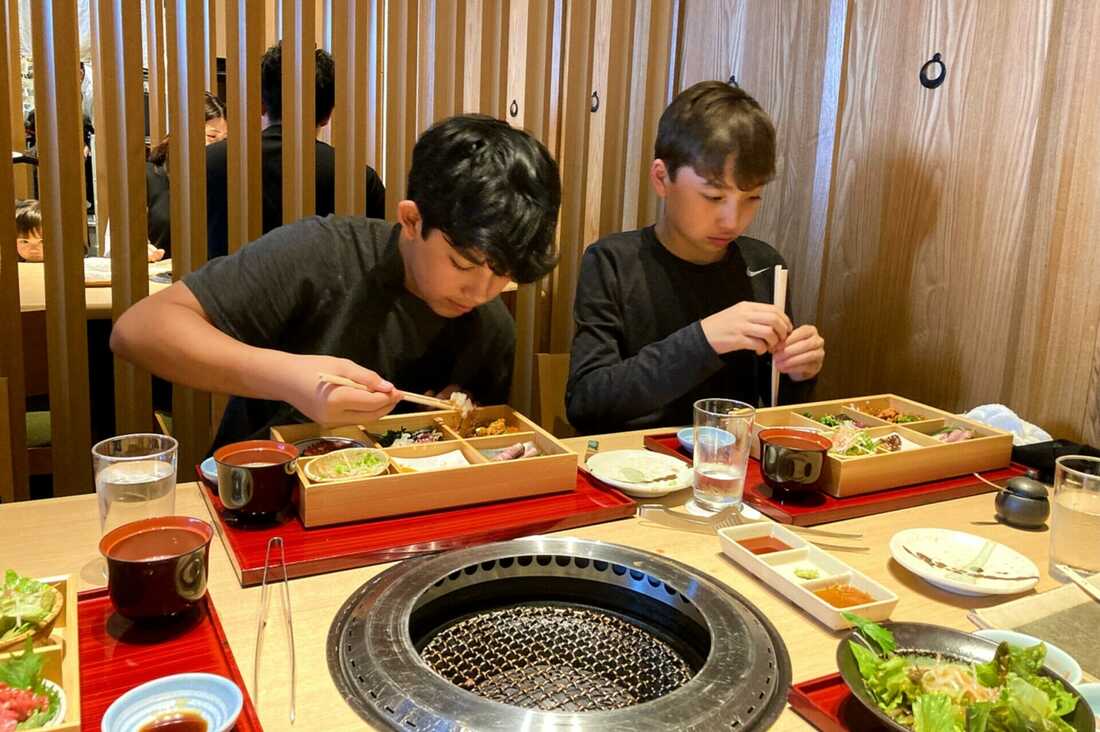
The author’s teen sons enjoy fresh lunch during a recent visit to Japan. Yuki Noguchi/NPR hide caption
toggle caption
Yuki Noguchi/NPR
The author’s teen sons enjoy fresh lunch during a recent visit to Japan.
Yuki Noguchi/NPR
I often think how revolutionary it would be for my life raising two teenage sons, if I had a Japanese conbini within walking distance from my house in suburban Washington DC. Most days, I try to adhere to a Japanese approach to food, which is actually an almost impossible commitment to keep, especially as a working solo parent.
It means driving, regularly, to half a dozen different grocery or specialty stores to stock fresh ingredients, like shrimp, dried seaweed (nori), or produce like Japanese yams and chives, then setting aside time throughout the day to wash, chop, cook and clean. (I also keep a small garden.) There is no other option I know of yet that meets my three golden criteria — healthy, economical and delicious.
I’m prone to griping: Why must eating fresh require taking on what feels like a second or third job? Many parent friends of mine seem to regard my efforts as laudable, maybe, but lunatic.
The reality is, I’m extremely lucky; there are so many privileges implicit in being able to prioritize fresh eating or healthy living in America. Modern life affords few families the time, money or access to the kinds of things I’m able to do (at least sometimes).
In three years covering health, I’ve come to understand how so many of the health problems in America stem from inequities that begin, at core, with what we grew up eating and the lifestyle we lived. So I also wonder how much better off we might be, as a population, if living or eating well wasn’t a burden we placed on individuals, but something our society supported — by design.
Photography by Yuki Noguchi. Editing and visual production by Carmel Wroth. The broadcast version of this story was edited by Jane Greenhalgh.
Share this Post
