 Enlarge this image
Sara Ariel Wong for NPR
Karla Mosley wants you to know that people with eating disorders look like her too.
“I’m a woman of color and I certainly didn’t know that people like me had eating disorders,” she says. “I thought it was a white, rich, female, adolescent disorder.”
Only one of those identifiers fits Mosley who’s black and binged and purged for years. But Mosley, an actor and a regular on the day time soap, The Bold and the Beautiful, is sharing her story of battling bulimia and getting her health back.
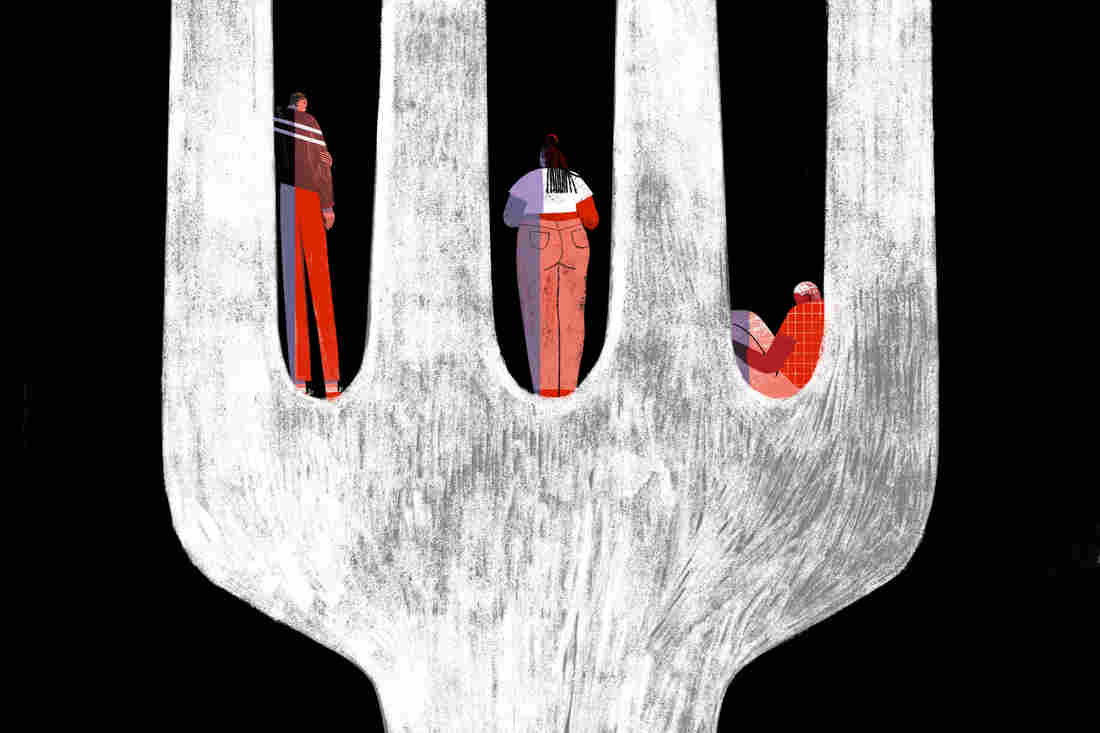
She’s part of a growing movement of people of color working to raise awareness in their own communities, and among researchers in the field, about how these disorders affect people of all backgrounds — and body types.
Mosley says she struggled for years with obsessive thoughts about food.
“I’ve experienced so many holidays and social events where I wasn’t present with people because I was focusing on what was on the table, what was going in my mouth, then once I ate it, ‘Is it going to make me fat the next day?’ ” she says.
Food haunted her at times. And it comforted her, at others. When she threw up, she says it was a way to purge pent up sadness and anxiety.
She says there was a time in her life when she was throwing up every single night. That was during a period in the early 2000s when she was working on a kids show, and hit rock bottom.
“At night, I was doing this very violent thing by myself, up all night, and during the day, I was smiling and laughing and entertaining children,” she recalls. “It was this very strange Dr. Jekyll, Mr. Hyde moment and I was barely keeping it together.”
Then her aunt, who was like a second mom, passed away. And, when she got that news, the first thing she did was run to the bathroom to throw up.
Her colleagues were aware this was going on…and begged her to get help.
She did. She sought treatment 16 years ago and she says she has been free from her eating disorder behaviors for the past decade.
Code Switch
Is Beauty In The Eyes Of The Colonizer?
She says she was lucky to have colleagues who supported her, and she knows not everyone has that luxury. Sharing the story of her eating disorder and her recovery is Mosley’s way of giving back and she uses her platform as a black actor with 60,000 Instagram followers.
“My picture shows up in their feed every day, that’s a wide range of people … It’s possible that by my telling my story, people can be helped,” she says.
Mosley is an ambassador for the largest non-profit in the U.S. helping people affected by eating disorders: The National Eating Disorder Association or NEDA. Over the past week, NEDA has been running its annual Eating Disorder Awareness campaign, focused on the theme of inclusivity, with the tagline: Come As You Are. The organization encourages people to share their stories using the hashtag #ComeAsYouAre.
View this post on Instagrammy lil ♥ is so happy. last night was just wOw. thank you so much to @bu_bodyproject and Bradley University for inviting me to speak for #NEDAwareness week. college was the rufffest time of my life & i really had no will to live at one point, drowning in endless responsibilities and inner struggles. Talking about tough topics to students and shedding a kind light on it all? That’s some full circle stuff right there honestly.. as a little girl, i never knew i had any potential to really do or be . SO. Thank you all for your love, support and care to better care for and love yourselves. We’re on this , ᴡɪʟᴅ journey together and i’m forever in awe of all of y o u✨ #edwarrior #nedaweek #selflove #recoveryispossible
A post shared by kelly u (@_kellyu) on Feb 28, 2019 at 10:48am PST
NEDA’s CEO Claire Mysko says she hopes people of all genders and racial and ethnic backgrounds participate.
“It’s really about, again, celebrating community and busting these myths that prevent and have prevented so many people from coming forward,” she says.
Mysko says 30 million Americans have struggled with an eating disorder at some point in their lives. And, that number’s probably higher, because the stereotype of who has an eating disorder affects how we talk about them, who seeks treatment, who gets treatment and how they’re treated.
Another myth that groups like NEDA want to dispel is the idea that people with eating disorders are all thin.
Chevese Turner, who founded the Binge Eating Disorder Association, or BEDA, in 2008, says that’s just not true.
She’s struggled with both binge eating disorder and atypical anorexia — that’s when you restrict your food intake and your calories, but you don’t look especially thin.
“I have always lived in a higher weight body,” she says. “Part of what the greater eating disorders community back in 2008 was not doing was really representing people in higher weight bodies with eating disorders.”
Binge eating disorder wasn’t recognized in the American Psychiatric Association’s diagnostic manual until 2013. Turner helped push for that change.
And, now that there’s more research on binge eating, she says demographic data is emerging.
“The Latino community actually has the highest rates of binge-eating disorder and they’re followed by the black community,” she says.
Mae Lynn Reyes-Rodriguez, a psychology researcher specializing in eating disorders, works primarily with unacculturated Latinas. She found that binge eating was common among her patients who crossed the border from Central America and Mexico and who had gone without food for much of the journey.
So, food insecurity may be a trigger. Trauma may also be a trigger, as well as anxiety and depression. But Reyes-Rodriguez says there’s so much we don’t know about how disordered eating affects the Latinx community. She’s not even sure the tools she’s using to diagnose her clients are working as well as they could be because they were developed and adapted for white women.
Turner, who’s white, wanted to address the lack of representation in the eating disorder advocacy world.
She invited an equity and inclusion expert, Desiree Adaway — who’s black — to speak at the Binge Eating Disorder Association’s annual conference a few years ago.
She says, Adaway got up on stage and said: “I just want to let you all know that this is a room full of white supremacy.”
“Until that point I had not really realized just how white our organizations were and just how much we were not listening,” says Turner.
Turner’s organization recently merged with NEDA to, “unify the eating disorder community.”
NEDA’s Mysko says they have a lot of work ahead when it comes to being more inclusive.
“As a white woman. I’m sort of putting forward that typical picture of who struggles,” she says.
NEDA doesn’t have a Latinx ambassador yet. But, they reached out to Gloria Lucas to help get the word out about Come As You Are.
Lucas says she felt the eating disorder community wasn’t serving her needs as a Latina with an eating disorder who identifies as “chubby.”
Her project, Nalgona Positivity Pride, provides information and support to people of color struggling with disordered eating.
View this post on InstagramA post shared by NPP (@nalgonapositivitypride) on Feb 26, 2019 at 9:37am PST
“Nalgona means a woman with a big butt. and it’s also slang, so I think that people relate to that,” she says. “Common people, that speak Spanish are like, ‘Oh, this is familiar.’ “
Lucas shares body-positive images and inspirational quotes to her 80,000 Instagram followers. She also gives talks at schools, universities and in bilingual book stores, wherever she can gather an audience of people of color to share her recovery story.
She talks about how she came to the realization that trying to prove her worth in a society that doesn’t value her was making her sick. Lucas says she believes that racism and historical trauma from colonialism play a significant role in why the Latinx community has eating problems.
She says she couldn’t afford treatment for her eating disorder. So she sought help on her own, looking up information online, reading books and attending Overeaters Anonymous meetings.
“It was the only free resource for me at that time and I was always the youngest or the only person of color,” she says. “I don’t recommend that to anybody because it’s extremely hard.”
She credits something she read in the book, A Hunger So Wide and So Deep, by Becky Thompson for helping her to stop blaming herself for binge eating.
“She states how eating disorders are sane reactions to insane circumstances,” Lucas says.
She hopes that idea resonates with other people of color who haven’t acknowledged their eating problems because of shame or embarrassment.
“I think that ‘Come as you are’ is like everybody from all different types of backgrounds,” she says. “Come as you are and talk about our struggles with food, right? Because eating disorders thrive in isolation.”
Share this Post
