 Enlarge this image
The writer in Amalfi, Italy, where her grandfather is from. Alan Martín Caudillo hide caption
toggle caption
Alan Martín Caudillo
The writer in Amalfi, Italy, where her grandfather is from.
Alan Martín Caudillo
Last March, grief tripped me.
Days before I would leave for the Amalfi Coast, I tumbled down my patio stairs. My partner heard the crash of glass and found me on the ground in the fervid New Mexico sun, my fingers clenching a mug’s handle, the only part intact. My right hand bled. My left knee throbbed.
For certain, I was giddy with anticipation to return to a beloved writing conference in Positano and to spend a few days in nearby Amalfi, where my father’s father was from. But lodged within the seams of my excitement also lived anxiety-ridden grief, stubborn and taut.
At the same time the year before, I was saying goodbye to my vivacious aunt Theresa, who was dying of a rare cancer. The ending came quicker than any of us expected. She and I had schemed about meeting in Italy after last year’s conference; instead, she passed weeks before. Ever since, my mother and two older sisters and I have felt the persistent sting and lingering dimness of her absence. Theresa was our glue. She hosted holidays, initiated getaways, phoned us to hear about our lives.
When I told my sisters and mother about my fall, which happened close to Theresa’s one-year deathiversary, I was surprised to learn all of them had fallen recently, too.
In therapy, I determined it was grief, sly and upending, that had robbed us of our balance. As a way of dodging grief’s latest takeover of our lives, we had disassociated ourselves from our minds, and in effect our bodies, enough to harm ourselves.
Shots – Health News
How your brain copes with grief, and why it takes time to heal
But I sensed something more was at play.
I reached out to Meghan Riordan Jarvis, a trauma-informed grief expert who specializes in how grief affects the body. Riordan Jarvis told me that because the death of a loved one is a completely novel experience, it is “very energetically expensive.” She confirmed that grief can impair our balance as well as memory and our ability to do multistep functions.
Riordan Jarvis suggested I contact neuroscientist and psychologist Mary-Frances O’Connor. I already knew of O’Connor, having previously devoured her book, The Grieving Brain. What had struck me most from it was that, after we lose someone, our brain undergoes a lengthy rewiring process that monopolizes our mental capacity and can be accompanied by brain fog.
Our implicit knowledge that our loved one will “always” be with us conflicts with our episodic memories, which include their death, so we are left contending with conflicting streams of information, which O’Connor calls the “gone-but-also-everlasting theory.” Our loved one is always here, at least in our virtual world. But in the physical world, they are gone, gone, gone.
Enlarge this image
Lauren and her beloved Aunt Theresa in Kauai in 2021. Melissa DePino hide caption
toggle caption
Melissa DePino
Lauren and her beloved Aunt Theresa in Kauai in 2021.
Melissa DePino
O’Connor told me she’d been working on a chapter in her next book about what I experienced, but what no one else seems to talk about — accidents that happen during bereavement. She shared that a study of over a million widows found that the bereaved are more likely to die from accidents than those still married. She said other studies are being conducted on suicide and cardiovascular disease during acute grief.
“Our capacity for balance is a necessary component of moving safely through the world,” she told me. “And it is reduced in many bereaved, as so much of the world has shifted from the normal granite that has always worked for them.”
After discussing my incident, she told me that she had biked into a parked car when she was experiencing what was likely the most difficult social stress of her life.
“I didn’t get hit by a car. I ran into the back of a parked car. It is clear my brain’s attention was not anywhere in my body …”
From a fall to a climb
I had forgotten about my fall until I boarded my flight to Italy and bumped my left knee on the seat in front of me. I winced. It was still tender.
The second my partner and I set foot at the central Piazza Duomo in Amalfi, I lifted my gaze to the trappings of a once-medieval town carved into the stony hillside overlooking the Tyrrhenian Sea: the lemon groves, viridescent with vegetation; the windows and balconies impossibly stacked over one another; and the laundry, draped and swaying, underwear offering welcome shade to people chattering over electric-orange Aperol spritzes.
I exhaled, remembering something O’Connor had written. If grief is a way of coaxing your brain to create new meaning in this physical world without our loved one, we must learn from all we have now — the present moment.
O’Connor writes, “I think of this present-moment awareness as wholeheartedness, engaging in what you are doing now in all aspects.”
I envisioned my whole heart hollowed and hallowed, not cumbersome and defective, as it had been feeling.
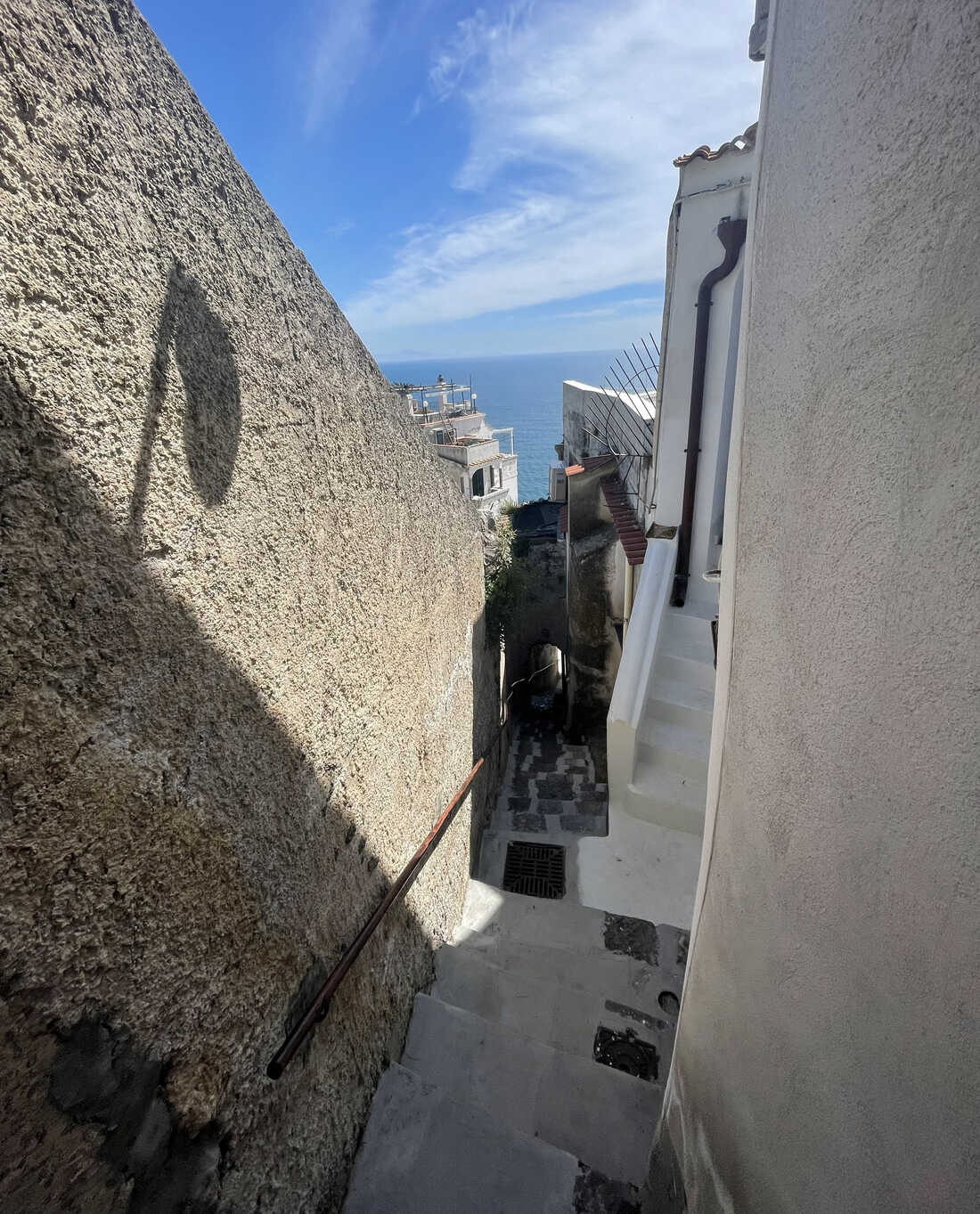
Anna and Maurizio, our Airbnb hosts, greeted us. Maurizio, who was in his late 60s, hoisted my 50-pound suitcase onto his back with a groan and started climbing, outpacing us. We struggled to trail him for the duration of 80 stairs, because these weren’t stairs like those you might go up and down in your home, every day, without thinking.
I had to muster all my energy to pay attention to every step. I felt a dull throb in my left knee, but carried on. Maurizio swerved left, up past the stand that sells lemon sorbetto in hollowed out lemons. The stairs were wide enough but uneven, and a handrail stretched on part of the way. Still. He made a sharp right to a narrower corridor, then veered up more stairs, walled by tall houses. We moved into single file.
Teal and navy shirts hung upside down from the windows, their arms reaching for us. A banister appeared and disappeared. Gates swung open and closed. All the while, I focused on each step so intently I could hear the echo of my breath.
If I raised my eyes, I saw how elevated we were. My stomach plunged. I had to kneel to regain my footing; one misstep could send me toppling six stories down to beach level.
Finally, we reached what resembled a houseboat with three compact rooms respectively on three floors, accessible only by more precipitous stairs.
During my stay, I began to see these challenging climbs throughout the town’s labyrinthic structure as an antidote to my fall, as a clearing after wading my way through grief’s brain fog.
The stairway up to Lauren’s accommodations in Amalfi. Alan Martín Caudillo hide caption
toggle caption
Alan Martín Caudillo
Forward, painstaking step after step
On my last day in Amalfi, my partner and I took yet another climb. We trekked to the cemetery that sits toward the top of the hill to see my ancestors’ graves. In awe I saw my last name in its original spelling (DiPino) on roughly every third grave. Visages from memorial portraits of someone’s famiglia, maybe mine, looked back at me, their large, dark eyes, familiar and comforting.
The stairs that took us there were numerous, rocky and unlevel. Back home, I had fallen down my patio stairs, stairs I had memorized, but I made it to the top of this town without as much as catching my foot.
When I lagged back down the hill navigating those craggy stairs with a painstaking finesse, I understood that when I fell on my patio, I was living in a daze. The same close attention that kept me from toppling into the cerulean sea that my grandfather stared at as a boy is the same intentionality I must apply to my own forward motion. To take one literal step at a time means seeing what’s burrowing in the cracks, noticing the moss and mildew that’s accumulated.
Grief can creep into our lives, months — even years — after our loved one has died. It can besiege our most joyfully anticipated experiences until we no longer see them as joyful. Not until we pay grief the attention it seeks can we live again.
I didn’t fathom the fierce concentration and the gaping vulnerability it takes to both climb inconstant stairs and brave the latest face of grief until I visited my grandfather’s hometown. I didn’t know I had disconnected from myself until my body hit the ground.
I fell. My sisters and my mother fell. Amalfi has fallen, too. Once the seat of a maritime republic, an earthquake, cholera, a plague and pirate raids threatened its longevity. But the town, sunny, whimsical and ever susceptible, survived, too. When I left for Italy, I saw myself as broken. But when I connected again with O’Connor, she reassured me.
“Often when people talk with me about having brain fog when they’re bereaved, it’s like they think they’re damaged. You’re not damaged. Your brain is simply busy trying to help you. But you need to help it as well by giving it awareness and self-compassion.”
While I found my counter-fall in Italy, I cannot know that I’ll never topple again, just as no one can say whether Amalfi or any city will. And when I feel myself spacing out, I will picture what it felt like to ascend toward Amalfi’s lapis sky, when it was me versus gravity. It took immense strength to balance on one foot, strength I had, even for the briefest moment, before I had to put the other foot down.
For now, I am paying intense attention — to every move, to every sting, to every rush of love.
Lauren DePino is a freelance writer, essay-writing coach, and songwriter. She is working on a memoir titled Funeral Singer: A Memoir of Holding on and Letting Go. Find more of her work at www.laurendepino.com.
Share this Post
