Explaining Medicine
  • News
  • Health & Lifestyle
    • Diet & Weight Management
    • Exercise & Fitness
    • Nutrition, Food & Recipes
    • Prevention & Wellness
  • Conditions
    • Custom1
      • Conditions A-Z
      • Procedures A-Z
      • Allergies
      • Alzheimer’s
      • Arthritis
      • Asthma
      • Blood Pressure
      • Cholesterol
      • Cancer
    • Custom2
      • Chronic Pain
      • Cold Flu
      • Depression
      • Diabetes
      • Digestion
      • Eyesight
      • Health Living
      • Healthy Kids
      • Hearing Ear
    • Custom3
      • Heart
      • HIV/AIDS
      • Infectious Disease
      • Lung Conditions
      • Menopause
      • Men’s Health
      • Mental Health
      • Migraine
      • Neurology
    • Custom4
      • Oral Health
      • Pregnancy
      • Senior Health
      • Sexual Health
      • Skin Problems
      • Sleep
      • Thyroid
      • Travel Health
      • Women’s Health
  • Medications
    • Medications
    • Supplements and Vitamins
  • Medical Dictionary
  • Health Alerts
Flu shot recommendation for kids dropped just as...
The CDC just sidelined these childhood vaccines. Here’s...
Your next primary care doctor could be online...
In Lodge Grass, Montana, a Crow community works...
RFK Jr.’s new dietary guidelines go all in...
More seniors are becoming homeless. Shelters are trying...
Health officials slash the number of vaccines recommended...
Wegovy obesity pill now available at pharmacies
One doctor’s experience shows the battle for the...
In the U.S., hunger is often hidden. But...
Top Posts

Explaining Medicine

  • News
  • Health & Lifestyle
    • Diet & Weight Management
    • Exercise & Fitness
    • Nutrition, Food & Recipes
    • Prevention & Wellness
  • Conditions
    • Custom1
      • Conditions A-Z
      • Procedures A-Z
      • Allergies
      • Alzheimer’s
      • Arthritis
      • Asthma
      • Blood Pressure
      • Cholesterol
      • Cancer
    • Custom2
      • Chronic Pain
      • Cold Flu
      • Depression
      • Diabetes
      • Digestion
      • Eyesight
      • Health Living
      • Healthy Kids
      • Hearing Ear
    • Custom3
      • Heart
      • HIV/AIDS
      • Infectious Disease
      • Lung Conditions
      • Menopause
      • Men’s Health
      • Mental Health
      • Migraine
      • Neurology
    • Custom4
      • Oral Health
      • Pregnancy
      • Senior Health
      • Sexual Health
      • Skin Problems
      • Sleep
      • Thyroid
      • Travel Health
      • Women’s Health
  • Medications
    • Medications
    • Supplements and Vitamins
  • Medical Dictionary
  • Health Alerts
  • News

    Honeybee deaths rose last year. Here’s why farmers would go bust without bees

    by Allison Aubrey July 3, 2023

    Enlarge this image

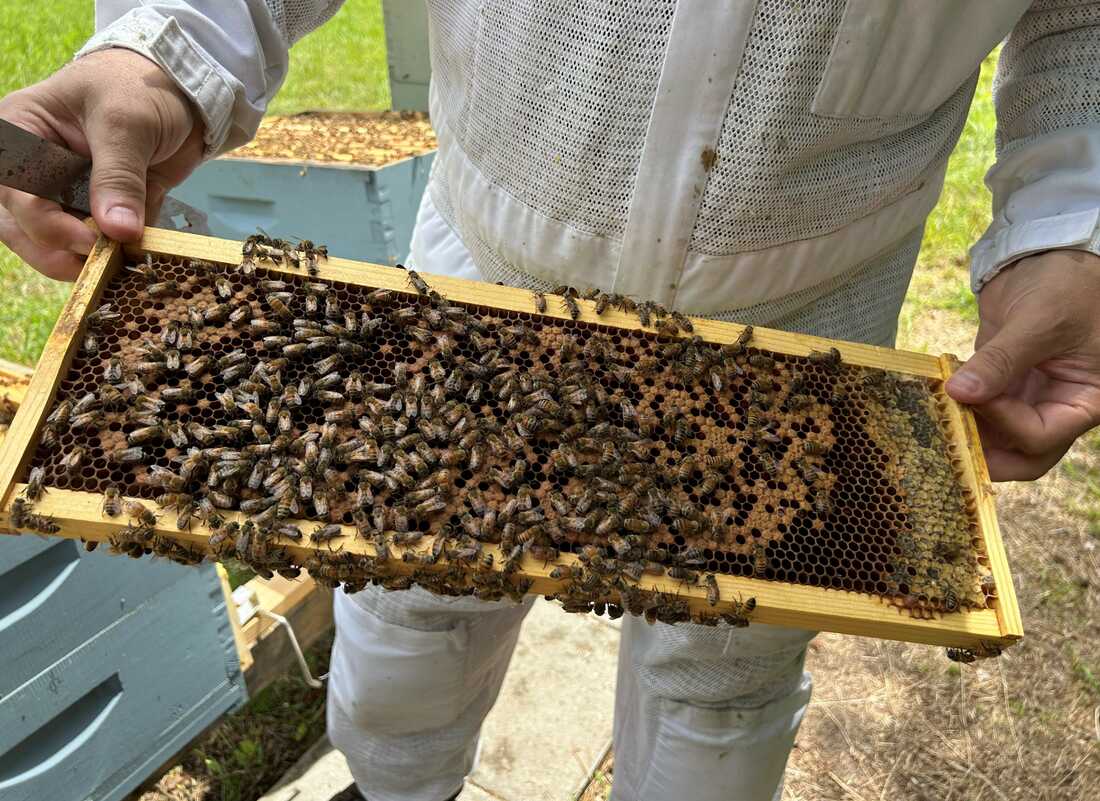
    Beekeeper Steven Reese inspects his hives at Bennett Orchards in Frankford, Del. Allison Aubrey/NPR hide caption

    toggle caption

    Allison Aubrey/NPR

    Beekeeper Steven Reese inspects his hives at Bennett Orchards in Frankford, Del.

    Allison Aubrey/NPR

    If you like to eat blueberries, apples, almonds and other fruits that require pollination, you can thank a honeybee. Farmers could not grow these crops without the essential service bees provide.

    “We depend on honeybees for our existence,” says Hail Bennett of Bennett Orchards in Frankford, Del., which has just opened its fields to u-pick visitors for peak season.

    Each spring, just as his blueberry bushes are flowering, Bennett rents loads of bees from a commercial beekeeper. For three weeks, the bees buzz around, moving millions of grains of pollen within and between flowers to pollinate the plants.

    “It’s pretty amazing how much work the bees have to do,” Bennett says. There are millions of flowers on his 6 acres of blueberries, and “each flower has to be visited six to eight times by a honeybee in order to be fully pollinated,” Bennett explains as he splits open a plump berry to inspect its seeds.

    “You want to have at least 15 seeds in the fruit, Bennett says, looking approvingly as he counts them. “That tells you the flower was adequately pollinated in the spring,” he says.

    Enlarge this image

    Each spring, just as his blueberry bushes are flowering, Hail Bennett rents bees from a commercial beekeeper to pollinate his plants. Allison Aubrey/NPR hide caption

    toggle caption

    Allison Aubrey/NPR

    Each spring, just as his blueberry bushes are flowering, Hail Bennett rents bees from a commercial beekeeper to pollinate his plants.

    Allison Aubrey/NPR

    Bennett recalls hearing stories about the collapse of honeybee colonies when he was in high school. Across the country bees were disappearing from their hives. Now, a new survey of beekeepers finds bees are still struggling.

    “Over the entire year, we estimate that beekeepers lost 48.2 % of their colonies,” says Dan Aurell, a researcher at Auburn University’s bee lab, which collaborates with the nonprofit Bee Informed Partnership to perform the survey.

    The report covers the period between April 2022 and April 2023 and included 3,006 beekeepers from across the U.S. This year’s count marks the second-highest estimated loss rate since 2010 to 2011, when the survey started recording annual losses.

    “This is absolutely a concern,” Aurell says. “This year’s loss rates do not amount to a massive spike in colony deaths, but rather a continuation of worrisome loss rates.”

    “It’s bad,” says former USDA research scientist Jeff Pettis, in regard to the survey findings. “It shows beekeepers are still being affected by a number of challenges,” he says. Beekeepers are finding they need to work harder to maintain their colonies, says Pettis, who is the president of Apimondia, an international federation of beekeepers associations.

    “A major concern for bees is the Varroa mite,” Pettis says. It’s a small parasite that feeds on bees and makes it difficult for them to stay healthy. “It shortens their lifespan,” Pettis says. According to the U.S. Department of Agriculture, Varroa is an invasive species that originated in Asia, and Pettis says beekeepers can use organic acids and other synthetic products to protect their bees.

    Pettis keeps bees on the Eastern Shore of Maryland, where he’s had some success using formic acid to treat against Varroa mites. “The organic acids are effective, but they do take time and money,” Pettis says.

    Enlarge this image

    Last year, beekeepers lost 48.2% of their colonies. It’s the second-highest loss since 2010 to 2011, when a survey started recording annual losses. Allison Aubrey/NPR hide caption

    toggle caption

    Allison Aubrey/NPR

    Last year, beekeepers lost 48.2% of their colonies. It’s the second-highest loss since 2010 to 2011, when a survey started recording annual losses.

    Allison Aubrey/NPR

    Other challenges bees face are beyond the control of any one beekeeper, Pettis says. They include the use of pesticides, a loss of nutrition sources for honeybees due to urbanization, or land use practices leading to fewer and less diverse food sources, such as wild flowers.

    There’s also a concern that can seem hidden in plain sight — climate change. “When you layer on the big, broad issues of climate change, bees are really struggling,” Pettis says.

    Blueberry farmer Hail Bennett says he aims to be a good steward of the land. He invited a hobbyist beekeeper, Steven Reese, to set up on his farm, which could help some of their visitors learn how crucial bees are to his operation, and to agriculture overall.

    Reese is retired from the Air Force and now works as a civilian for the Army. He says beekeeping is relaxing for him, almost a form of meditation. He says it is work to manage his bees, but he’s been able to maintain his numbers, and grow his colonies, by dividing hives when some of the bees die. “If I left them feral, so to speak, and allowed them to survive on their own, it would be a much higher loss rate,” so the effort is worth it, he says.

    Reese says bees never cease to amaze him, with their hive instincts and sophisticated ways of organizing themselves. “They communicate in phenomenal ways,” he says.

    For farmer Hail Bennett, the bee is paramount. Without bees there are no blueberries.

    “It’s important for people to understand and remember where their food comes from,” Bennett says.

    Read the article here

    Share this Post

    Share Explaining Medicine Share Explaining Medicine

    Honeybee deaths rose last year. Here’s why farmers would go bust without bees was last modified: July 14th, 2023 by Allison Aubrey

    Related

    Bee deathsblueberriesfarmershoneybees
    0 comment
    0
    Facebook Twitter Google + Pinterest
    Allison Aubrey

    previous post
    A step-by-step guide to finding a therapist
    next post
    Abortion access could continue to change in year 2 after the overturn of Roe v. Wade

    Related Articles

    Genuine empathy goes a long way

    December 17, 2018

    Just Lost Your Job? COBRA May Be Your Best Health Insurance Strategy Now

    June 13, 2017

    Women With Heart Attack Do Better If Doc is Female

    August 6, 2018

    Avoiding The Ouch: Scientists Are Working On Ways To Swap The Needle For A Pill

    February 7, 2019

    Insurance Companies Are Prime Targets for Hackers

    September 25, 2018

    Commentary: Can Oklahoma Eliminate Overdose Deaths?

    March 8, 2019

    Evanger’s Dog Food Recall Expanded

    March 7, 2017

    6 ways to ensure you’re not accepting a terrible health care job

    December 15, 2018

    Stimulating Brain Area May Ease Tough Depression

    November 30, 2018

    Steep Rise in Births to U.S. Women Using Opioids

    January 17, 2017

    Recent Posts

    • Flu shot recommendation for kids dropped just as the illness rages

      January 12, 2026
    • The CDC just sidelined these childhood vaccines. Here’s what they prevent

      January 9, 2026
    • Your next primary care doctor could be online only, accessed through an AI tool

      January 9, 2026
    • In Lodge Grass, Montana, a Crow community works to rebuild from meth’s destruction

      January 8, 2026
    • RFK Jr.’s new dietary guidelines go all in on meat and dairy

      January 7, 2026

    Keep in touch

    Facebook Twitter Google + RSS

    Recent Posts

    • Flu shot recommendation for kids dropped just as the illness rages

      January 12, 2026
    • The CDC just sidelined these childhood vaccines. Here’s what they prevent

      January 9, 2026
    • Your next primary care doctor could be online only, accessed through an AI tool

      January 9, 2026
    • In Lodge Grass, Montana, a Crow community works to rebuild from meth’s destruction

      January 8, 2026
    • RFK Jr.’s new dietary guidelines go all in on meat and dairy

      January 7, 2026
    • Terms of Service
    • Privacy Policy

    @2026 - Explaining Medicine. All Right Reserved.


    Back To Top
    Explaining Medicine
    Proudly powered by WordPress Theme: soledad child.