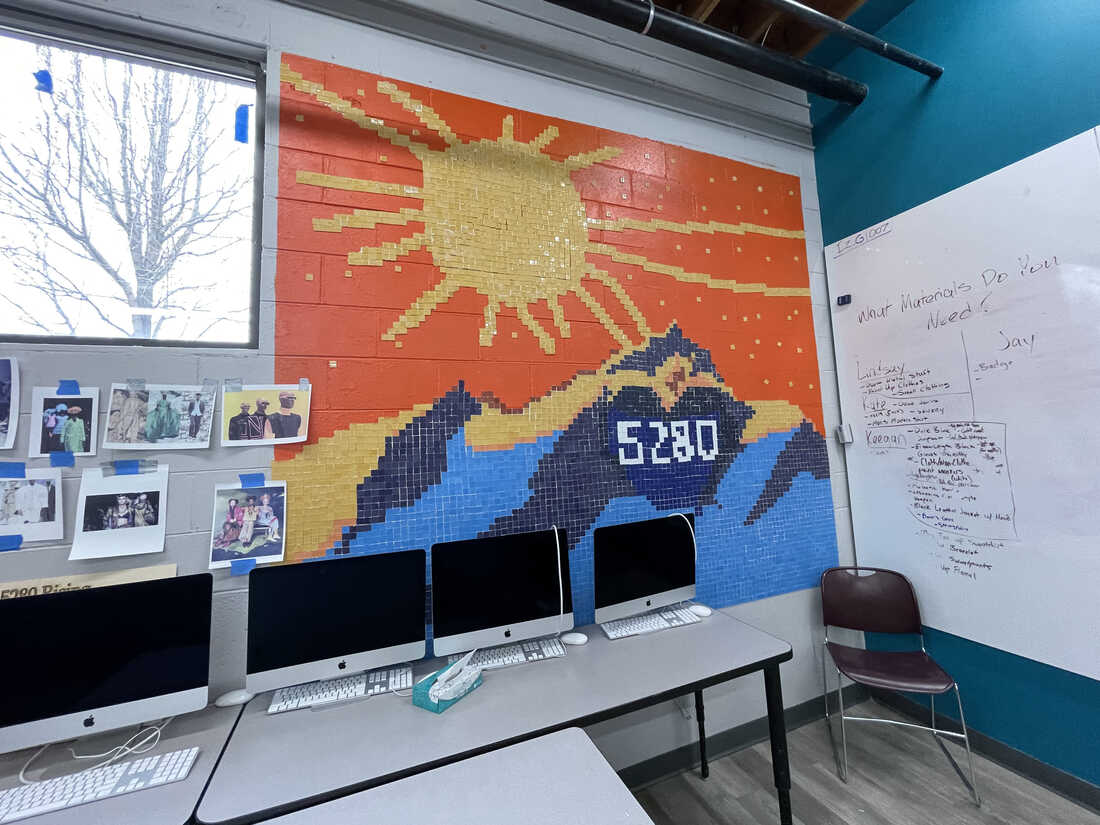
 Enlarge this image
5280 High School in Denver is one of 43 secondary schools in the U.S. with a program designed for students recovering from substance use disorder and related mental health disorders. Stephanie Daniel/KUNC hide caption
toggle caption
Stephanie Daniel/KUNC
5280 High School in Denver is one of 43 secondary schools in the U.S. with a program designed for students recovering from substance use disorder and related mental health disorders.
Stephanie Daniel/KUNC
Every weekday at 5280 High School in Denver starts the same way.
Students in recovery from drug and alcohol addiction gather on the steps of the school’s indoor auditorium to discuss a topic chosen by staff members. One recent morning, they talked about mental health and sobriety. A teenage boy dressed in tan corduroys, a black hoodie, and sneakers went first.
“I didn’t want to have, like, any emotion,” he said. “So I thought, like, the best way to, like, put it down would be to do more and more and more drugs.”
A classmate said she started doing drugs for fun and then got hooked. Another student said his addiction negatively impacts his mental health. A third announced an upcoming milestone.
“In, like, two days, I’ll be six months sober,” she said, as her classmates cheered.
The students attend Colorado’s only recovery high school — one of 43 nationwide. These schools are designed for students who are recovering from substance use disorder and might also be dealing with related mental health disorders. The Denver school opened in 2018 as a public charter school that today enrolls more than 100 students.
This story was produced in partnership with Kaiser Health News.
One of those cheering classmates was sophomore Alexis Castillo, 16, who listened supportively during that recent morning meeting. She is in recovery for alcohol and fentanyl addictions. Several of her friends attended the school when she enrolled during her freshman year and initially loved it. But after a while some of Castillo’s friends left and she grew disillusioned. She stopped going to class and wasn’t motivated to work her recovery steps.
“They give you a lot of accountability,” she said. “That was not something I wanted.”
Castillo relapsed and school staffers helped her get into rehab. Three months later she was back at the school, in recovery and ready to do the work.
The school’s mission is to help kids learn to live a substance-free life while receiving an education. This includes attending recovery meetings and wellness activities, and taking traditional high school classes like English, math, and Spanish.
“They can go on to college or a career and really handle anything that life throws at them,” said 5280’s founder and executive director, Dr. Melissa Mouton.
In 2022, nearly a third of 12th graders and 1 in 5 10th graders reported using an illicit drug in the previous year, according to a national survey from the Monitoring the Future project conducted by the University of Michigan Survey Research Center. Those numbers have steadily decreased over the past 25 years. However, data from UCLA shows overdose deaths among teens doubled in the first year of the pandemic, mainly attributed to the increased prevalence of fentanyl-laced drugs.
The first recovery high school opened in Silver Spring, Md., in 1979 and similar programs now operate in 21 states. Compared with their peers at regular schools who have gone through treatment, recovery high school students have better attendance and are more likely to stay sober, and their graduation rate is at least 21% higher, according to one study.
Enlarge this image
A mosaic in the computer lab at 5280 High School in Denver. Colorado’s only high school with a recovery program opened in 2018 as a public charter school and today enrolls more than 100 students. Stephanie Daniel/KUNC hide caption
toggle caption
Stephanie Daniel/KUNC
A mosaic in the computer lab at 5280 High School in Denver. Colorado’s only high school with a recovery program opened in 2018 as a public charter school and today enrolls more than 100 students.
Stephanie Daniel/KUNC
“For this particular group of young people who have these disorders, this can be a lifesaver,” said John Kelly, director of the Recovery Research Institute at Massachusetts General Hospital. “It can help them create a social norm of recovery.”
There are three components to effective drug and alcohol treatment, according to Dr. Sharon Levy, a pediatrician and addiction medicine specialist at Boston Children’s Hospital. The first part is medical, which includes seeing a doctor, drug testing, and using medications like buprenorphine to treat opioid addiction. The second is emotional support from counseling to address co-occurring mental health disorders. And there is a behavioral component that, for kids, can include receiving positive feedback from parents, peer support and recovery schools.
“Recovery schools offer an opportunity really for peer support and mutual aid in a kind of a supervised and structured way,” Levy said.
Recovery high schools often weave components of treatment into the school day — activities like 5280’s daily recovery program meeting. In the afternoon, the school offers wellness electives such as spiritual principles and journaling. The school also employs a director of recovery and recovery coach to work with and counsel the students individually.
Recovery schools do face challenges. Most are publicly funded charter or alternative schools that carry a higher cost of educating students than traditional schools do. This is due to a smaller enrollment, the need for mental health and recovery personnel, higher faculty-to-student ratios, and other factors.
The Denver school enrolls about 100 students annually, making it one of the biggest recovery high schools in the nation. This year, the per-pupil cost is about $25,000 per student but the school receives only about $15,000 from federal, state, and local funding, according to Mouton. The remaining money comes from donors.
Given the complex needs of the students, “recovery schools will always be small,” she said.
Pooling such students together may also raise a concern that students will trigger one another to use drugs and alcohol and relapse, but, Levy said, that’s a risk with any social interaction.
“So, if you’re in an environment where the recovery is kind of front and center and people are watching and monitoring and supervising,” she said, “I think that’s helpful for a lot of kids.”
The school in Denver purposely keeps enrollment under capacity so additional teens can enroll anytime during the school year. A student won’t get kicked out if they relapse, but there are two requirements: They must want to be sober and attend an outside recovery program.
“The No. 1 step is just letting them know out of the gate, no matter what’s going on, that we love them,” said Brittany Kitchens, the school’s recovery coach. “We are here for them.”
Kitchens teaches students how to navigate recovery and regulate their emotions. She likens herself to a hall monitor, constantly checking in with students and looking for changes in behavior.
“I tend to be the first kind of line that the kids will come to when they’re experiencing something that is just a little bit too big for them to process,” she said.
Some of these difficulties stem from traumas students have experienced, including sex and drug trafficking, and abandonment. Students also deal with traumas they have caused, Kitchens said, actions that landed them in jail or on probation.
Kitchens, who is in recovery herself, shares coping mechanisms with the students.
“A lot of times it just starts with, ‘Hey, take a breath, breathe in through the nose and out through the mouth,'” she said.
Alexis has been in recovery for nearly a year, she said. The morning meetings where she and her classmates talk about mental health, sobriety, and other topics are an opportunity to build a community of friends who support one another, something she said she didn’t have when she was using drugs.
“It’s really hard to get sober young,” she said.
This article is part of a partnership that includes KUNC, NPR, and KHN.
KHN (Kaiser Health News) is a national newsroom that produces in-depth journalism about health issues. Together with Policy Analysis and Polling, KHN is one of the three major operating programs at KFF (Kaiser Family Foundation). KFF is an endowed nonprofit organization providing information on health issues to the nation.
Share this Post
