 Enlarge this image
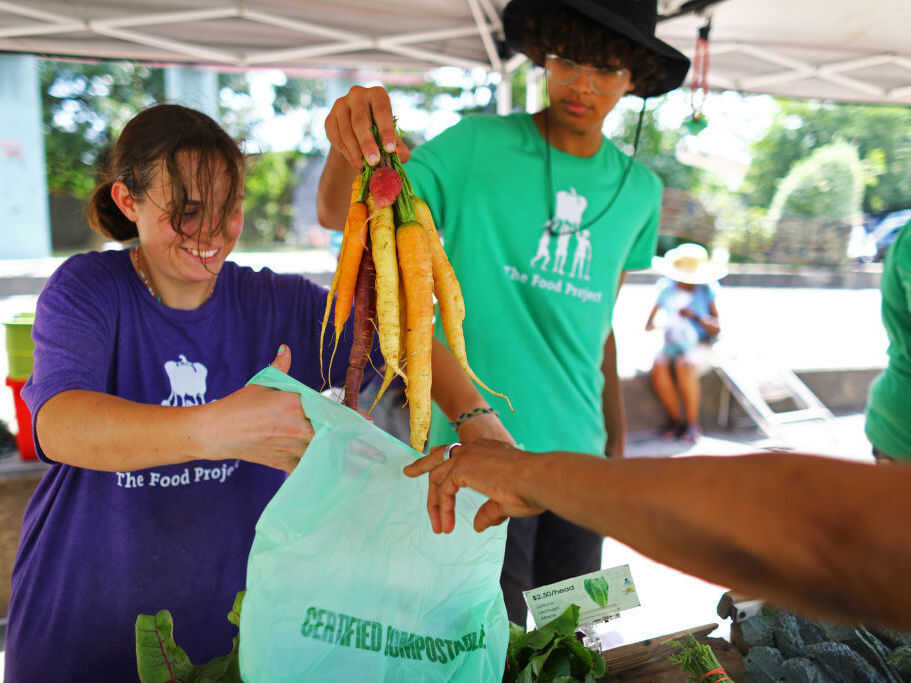
The U.S. food system makes junk food plentiful and cheap. Eating a diet based on whole foods like fresh fruit and vegetables can promote health – but can also strain a tight grocery budget. Food leaders are looking for ways to improve how Americans eat. FREDERIC J. BROWN/AFP via Getty Images hide caption
toggle caption
FREDERIC J. BROWN/AFP via Getty Images
The U.S. food system makes junk food plentiful and cheap. Eating a diet based on whole foods like fresh fruit and vegetables can promote health – but can also strain a tight grocery budget. Food leaders are looking for ways to improve how Americans eat.
FREDERIC J. BROWN/AFP via Getty Images
The data are stark: the typical American diet is shortening the lives of many Americans. Diet-related deaths outrank deaths from smoking, and about half of U.S. deaths from heart disease – nearly 900 deaths a day – are linked to poor diet. The pandemic highlighted the problem, with much worse outcomes for people with obesity and other diet-related diseases.
“We’re really in a nutrition crisis in this country.” says Dariush Mozaffarian, a cardiologist and dean of the Friedman School of Nutrition Science and Policy at Tufts University
Now, there’s growing momentum to tackle this problem. The Biden administration will hold the White House Conference on Hunger, Nutrition, and Health on September 28th, and will announce a new national strategy. This comes more than 50 years after a landmark White House conference which helped launch today’s major federal food assistance programs.
“The 1969 conference was transformative,” Mozaffarian says. The programs it ushered in, like the WIC program, have helped feed millions of low-income families.
But this hasn’t been enough to solve the dual problems of food insecurity and diet-related disease. Food policy leaders say it’s time to think anew and build on what we’ve learned. The U.S. can’t “fix” hunger by just feeding people cheap, high-calorie, processed foods – the food that’s so abundant in our food supply, they say. Instead, it’s got to find ways to nourish people with healthy, nutrient-dense foods.
Politics
Biden’s goal to end hunger by 2030 and his new food conference, explained
“There’s a lot of enthusiasm and thinking about food more broadly and how we can fix this crisis,” Mozaffarian told NPR. He’s co-chair of an independent task force that includes doctors, chefs, food policy and business experts, as well as farming and health advocates, who are helping form the agenda at upcoming the White House conference.
In a new report, they’ve proposed a wide-ranging set of recommendations to end hunger, advance nutrition and improve health. Here are seven big ideas they’re excited about.
Enlarge this image
Nutrition advocates say SNAP and WIC benefits, which give low-income families money for groceries, could be designed to incentivize buying more fresh produce. Justin Sullivan/Getty Images hide caption
toggle caption
Justin Sullivan/Getty Images
Nutrition advocates say SNAP and WIC benefits, which give low-income families money for groceries, could be designed to incentivize buying more fresh produce.
Justin Sullivan/Getty Images
1. Treat food as medicine
There’s a growing movement to integrate food and nutrition into health care, by providing healthy meals and groceries to patients to help prevent or manage diet-related illness.The task force wants to see this kind of work expand.
“We should pay for food-based interventions that are effective,” Mozaffarian says.
For example, there’s mounting evidence that providing prescriptions for fruit and vegetables can spur people to eat better and manage weight and blood sugar. The idea is for health care systems or insurers to provide or pay for healthy groceries, combined with nutrition education, to help patients change their eating habits. It is being piloted around the country.
“Produce prescription programs help improve diet quality and food security,” says task force member Dr. Hilary Seligman, a food insecurity expert and professor of medicine at University of California, San Francisco, noting that they can help with diet-related diseases like high blood pressure and diabetes.
Another idea is to offer medically tailored meals aimed at helping people who are already sick reverse chronic disease. Currently the federal government is running pilot programs that let Medicaid or Medicare pay for the meals in several states.
The Salt
Fresh Food By Prescription: This Health Care Firm Is Trimming Costs — And Waistlines
2. Focus on quality of calories, not just quantity
The U.S. food supply is awash in cheap calories. And when you’re on a tight budget or relying on benefits like SNAP (food stamps), processed foods like chips and soda can set you back less than fresh produce. Of course, eating processed foods also contributes to cardiovascular disease, stroke, diabetes and other chronic illnesses, warns Nancy Brown, CEO of the American Heart Association.
Brown says federal food assistance programs have helped to address hunger. “However, many U.S. food policies and programs focus on improving access to sufficient quantities of food,” she says. Instead, it’s time to modernize these policies and focus on the quality of food, “so people have access to enough nutritious food.”
The task force wants to see food programs redesigned to nudge people towards healthier options. The report points to the GusNIP nutrition incentive program – which, in select communities – gives SNAP participants more money to buy fruit and vegetables. It’s a similar concept to the Double Bucks program which doubles the value of SNAP benefits when used to buy produce at farmers markets and other venues.
“It is important to scale up these efforts to ensure that everyone has access to healthy food options,” says task force member Angela Odoms-Young, a nutrition professor at Cornell University.
The task force recommends that Congress establish a nationwide produce incentive program for all SNAP participants. “These types of programs can help promote equity,” Odoms-Young says, noting that people of color disproportionately suffer from chronic illnesses.
Enlarge this image
To nudge people to eat more fruits and vegetables, one idea is to expand access to programs that give SNAP beneficiaries more money when they buy produce at places like farmer’s markets. Boston Globe/Boston Globe via Getty Images hide caption
toggle caption
Boston Globe/Boston Globe via Getty Images
To nudge people to eat more fruits and vegetables, one idea is to expand access to programs that give SNAP beneficiaries more money when they buy produce at places like farmer’s markets.
Boston Globe/Boston Globe via Getty Images
3. Expand access to dietary and lifestyle counseling
The Affordable Care Act mandates that diet counseling be covered by insurers as a preventive care benefit for those at higher risk of chronic disease. The exact details of who is eligible for which services are left up to an advisory group of doctors and health care providers, as well as insurers, and many patients who would benefit may not have access to this service.
“The vast majority of Americans should be getting preventative behavioral lifestyle treatment,” Mozaffarian says. Too often, he says, doctors prescribe drugs for conditions before recommending or trying lifestyle changes. “Doctors go right to the drug,” he says. “I think that’s a big problem.”
The task force recommends that Congress expand Medicare and Medicaid coverage for medical nutrition therapy to people with high blood pressure, prediabetes, celiac disease, HIV/AIDS, cancer and other diet-related conditions. It also calls for expanded coverage of cooking classes and nutrition assistance, as well as coverage of the Diabetes Prevention Program, delivered by telehealth. This behavior-change program has been shown to be more effective than medicine in reducing the onset of Type 2 diabetes among people at high risk.
4. Support food entrepreneurs
People who start food businesses can help nourish their communities and create jobs. The task force calls on the federal government to pass policies that boost new healthy food enterprises, including providing new loans and grants to food and nutrition-related companies centered on health, equity, and sustainability. The idea is to focus especially on businesses owned by people of color and other marginalized groups.
“We don’t need more businesses creating diabetes and obesity,” says Tambra Raye Stevenson, who runs Wanda, a non-profit group that aims to build a pipeline and platform for a million Black women and girls to become local food leaders. “We need entrepreneurs that provide teaching kitchens, community gardens, healthy food retails, wellness studios, nutrition services, healthy consumer products, and urban agricultural centers,” she says.
She points to food entrepreneurs like Amanda Stephenson who opened a specialty food market in an underserved neighborhood in Washington, DC, Fresh Food Factory, and Mary Blackford of Market 7 who is planning a food hall that features Black-owned food and lifestyle businesses. “They are our food she-roes making a positive impact and providing healthy food access for our children and other women,” says Stevenson.
In the lead up to next month’s White House conference, groups like Food Tank, a food think tank, have organized listening sessions with food researchers and entrepreneurs. “For food to be more accessible and affordable, we need entrepreneurs that use science and technology,” says Danielle Nierenberg of Food Tank. She points to innovators like Journey Foods which is helping entrepreneurs bring nutritious foods and snacks to market.
5. Increase the number of new farmers growing healthy foods using regenerative farming techniques
If all Americans began to eat the recommended amounts of fruits and vegetables each day, there would be shortages. That’s because corn and soybeans are grown on most cropland in the U.S.. Now, there’s growing recognition of the need for more specialty crops – including fruits, vegetables, and nuts.
The task force recommends that Congress create a Farmer Corps to support new farmers, building on the Beginning Farmers and Ranchers Development Program. The idea is to provide new farmers with paid internships and apprenticeships to learn about sustainable farming, and funding to cover a living wage and housing. It also is pushing for loans to go to farmers growing with sustainable practices.
Growing the same crop, season after season, as many farmers do, can make lands less productive over time, and deplete nutrients from the soil.”The unfortunate reality is that today we subsidize conventional practices that degrade the soil,”says David Montgomery, a professor at the University of Washington and the author of What Your Food Atewho attended a listening session.
“What we need to sustain agriculture is to incentivize restoring healthy soils and train more farmers to be successful doing that,” he says.
6. Make school meals free for all students
School meals have been a fixture in U.S. schools ever since President Harry Truman signed the National School Lunch Act back in 1946. For decades, the federal government has reimbursed schools for meals they serve, and low-income students can qualify for free or reduced priced meals. Research has shown that low-income children who participate have better health.
Politics
As students go back to school, many face a lunch bill for the first time in 2 years
Yet, many families who are eligible for free or reduced-priced meals may not receive them, sometimes due to the paperwork, bureaucracy or stigma of participating or enrolling. Amid the pandemic, school meals have been offered for free to all students. Now, the task force says this should be a permanent change.
“Without access to free meals at school, many children go without food at all during the day, and many more do not have access to the nutritious foods they need to thrive,’ says Seligman, of UC, San Francisco. She notes that school meals help not only with kids’ nutrition, but they also reduce absenteeism and improve academic outcomes.
7. Establish a federal ‘food czar’
In order to turn ideas like these into action, the task force recommends the creation of a new role in the federal government, a national director of food and nutrition, a food czar figure, if you will. The new director would help streamline and coordinate the many disparate efforts already underway. The U.S. government spends more than $150 billion each year on food and nutrition related programs, and the health care system also spends billions on treatment of diet related diseases.
“This spending is fragmented across 200 separate actions and 21 different departments and agencies without harmonization or synergy,” the task force concludes. Now, they conclude, it’s time for a new approach.
Share this Post
