Explaining Medicine
  • News
  • Health & Lifestyle
    • Diet & Weight Management
    • Exercise & Fitness
    • Nutrition, Food & Recipes
    • Prevention & Wellness
  • Conditions
    • Custom1
      • Conditions A-Z
      • Procedures A-Z
      • Allergies
      • Alzheimer’s
      • Arthritis
      • Asthma
      • Blood Pressure
      • Cholesterol
      • Cancer
    • Custom2
      • Chronic Pain
      • Cold Flu
      • Depression
      • Diabetes
      • Digestion
      • Eyesight
      • Health Living
      • Healthy Kids
      • Hearing Ear
    • Custom3
      • Heart
      • HIV/AIDS
      • Infectious Disease
      • Lung Conditions
      • Menopause
      • Men’s Health
      • Mental Health
      • Migraine
      • Neurology
    • Custom4
      • Oral Health
      • Pregnancy
      • Senior Health
      • Sexual Health
      • Skin Problems
      • Sleep
      • Thyroid
      • Travel Health
      • Women’s Health
  • Medications
    • Medications
    • Supplements and Vitamins
  • Medical Dictionary
  • Health Alerts
Flu shot recommendation for kids dropped just as...
The CDC just sidelined these childhood vaccines. Here’s...
Your next primary care doctor could be online...
In Lodge Grass, Montana, a Crow community works...
RFK Jr.’s new dietary guidelines go all in...
More seniors are becoming homeless. Shelters are trying...
Health officials slash the number of vaccines recommended...
Wegovy obesity pill now available at pharmacies
In the U.S., hunger is often hidden. But...
One doctor’s experience shows the battle for the...
Top Posts

Explaining Medicine

  • News
  • Health & Lifestyle
    • Diet & Weight Management
    • Exercise & Fitness
    • Nutrition, Food & Recipes
    • Prevention & Wellness
  • Conditions
    • Custom1
      • Conditions A-Z
      • Procedures A-Z
      • Allergies
      • Alzheimer’s
      • Arthritis
      • Asthma
      • Blood Pressure
      • Cholesterol
      • Cancer
    • Custom2
      • Chronic Pain
      • Cold Flu
      • Depression
      • Diabetes
      • Digestion
      • Eyesight
      • Health Living
      • Healthy Kids
      • Hearing Ear
    • Custom3
      • Heart
      • HIV/AIDS
      • Infectious Disease
      • Lung Conditions
      • Menopause
      • Men’s Health
      • Mental Health
      • Migraine
      • Neurology
    • Custom4
      • Oral Health
      • Pregnancy
      • Senior Health
      • Sexual Health
      • Skin Problems
      • Sleep
      • Thyroid
      • Travel Health
      • Women’s Health
  • Medications
    • Medications
    • Supplements and Vitamins
  • Medical Dictionary
  • Health Alerts
  • Slideshows

    Rotator Cuff Injury: Causes, Symptoms, and Surgery

    by explainingmedicine October 14, 2016

    Rotator Cuff Injuries

    Rotator cuff tears can be career-ending for professional athletes and are one of the most common causes of shoulder pain for everyday folks. So, what is a rotator cuff and how can it tear?

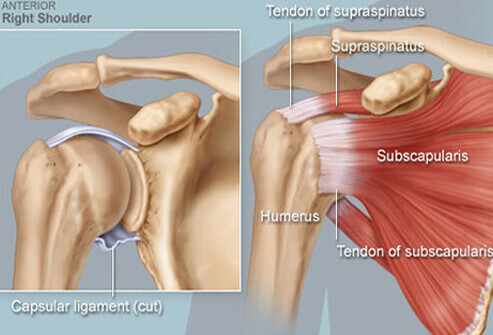
    Shoulder Anatomy: The Rotator Cuff

    The rotator cuff refers to a group of four tendons and muscles that form a "cuff" to stabilize the shoulder joint and keep the arm in the shoulder socket, while allowing it to move in different directions.

    The shoulder joint is stable because of the rotator cuff, but it is also relatively weak. Acute injuries or repetitive stress and strain on the joint can cause swelling and tears in the tendons.

    What Are the Causes?

    Most of the time, rotator cuff injuries are caused by repetitive stress on the rotator cuff, or degeneration caused by aging. Such repetitive stress can include injuries sustained from sports, particularly those that require a lot of shoulder movement such as baseball, tennis, swimming, weightlifting, and football.

    As we age, reduced blood supply to the rotator cuff tendons means damage does not repair itself as well, and bone spurs (bony overgrowths) can also weaken the tendon and lead to tears.

    Acute injuries caused by falling, using an arm to break a fall, or lifting heavy items with a jerking motion can also lead to rotator cuff tears.

    Acute Rotator Cuff Tear

    An acute rotator cuff tear occurs when there is excessive force exerted on the rotator cuff tendon. The amount of force needed to tear a rotator cuff tendon varies from person to person and the condition of their rotator cuff tendon prior to trauma. In a person with a healthy tendon, it could require the stress of a fall, landing on an outstretched arm to tear the tendon. But if the tendon has pre-existing degeneration, the force require for it to tear may be modest, such as lifting a moderately heavy object.

    Chronic Tear

    Chronic rotator cuff tears are commonly seen in people whose occupations or sports require them to reach their arms overhead frequently, such as in baseball pitchers, tennis players, or even painters. Use of the arm in such a position causes repetitive trauma to the rotator cuff muscles and tendons.

    Tendinitis

    As we age, the blood supply to the tendons is reduced which can lead to longer healing times after injury. In addition, muscles degenerate. All this can lead to tendinitis (tendon inflammation), which can make a person more prone to a rotator cuff tear.

    What Are the Symptoms?

    Symptoms of rotator cuff injuries are due to inflammation and swelling in the rotator cuff and include:

    • Pain in the shoulder and arm. Pain is felt often at night when lying on the affected shoulder.
    • Pain may also be felt when moving the arm in certain ways. The pain stops before the elbow.
    • If the injury is acute (sudden) pain will be intense and immediate.
    • If the injury is degenerative (damage occurs over time) the pain may be mild at first.
    • Weakness or loss of motion in the arm or shoulder.
    • A grating or snapping sensation or cracking sound when moving the shoulder.

    When to See the Doctor

    Any time you have an acute shoulder injury, or chronic shoulder or arm pain, you should see a doctor for a diagnosis and treatment. If your shoulder pain persists despite rest, ice, and anti-inflammatory medications, if you can no longer perform your daily activities, if you cannot reach overhead, or you can no longer participate in a sport you used to, see a doctor. Early diagnosis of a rotator cuff tear can make a big difference in recovery and prevent loss of strength and motion.

    Should You Go to the ER?

    If your injury is acute (sudden) such as from a severe fall or accident, go to a hospital's emergency department. If you suspect a bone is broken, if you have an open wound or a bone protruding from the wound, if you experience any numbness in the arm or hand, or if you cannot move your shoulder, go to an emergency department.

    Exams & Diagnosis

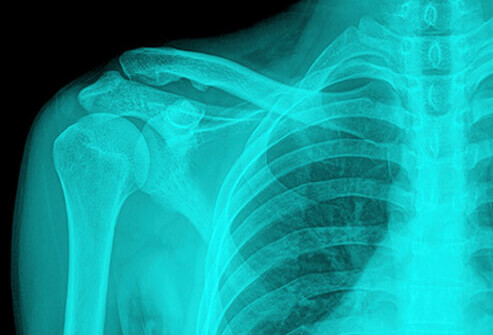
    A rotator cuff injury is diagnosed first with a physical exam where a doctor will move your arm in different directions to assess your pain levels and range of motion. Tests for a rotator cuff tear may include:

    • X-ray
    • MRI (magnetic resonance imaging)
    • Ultrasound
    • Arthrogram - a special type of X-ray that uses dye injected into a joint to more clearly see detail in the tendons and muscles

    Treatment Options

    The first line of treatment for rotator cuff injuries that are mild to moderate includes rest, ice, and anti-inflammatory medications such as NSAIDs including ibuprofen (Advil, Motrin). Avoid using the shoulder if it hurts.

    Physical therapy for rotator cuff injuries is used to make the shoulder stronger and more flexible. In some cases, steroid injections such as cortisone may be used to relieve pain and inflammation.

    Most of the time, surgery is not needed to repair a rotator cuff injury, except in severe cases where the tendon may be completely torn, the injury is acute, or the pain is chronic and has not been helped by other treatments. Following surgery, physical therapy is still needed.

    Surgical Treatments

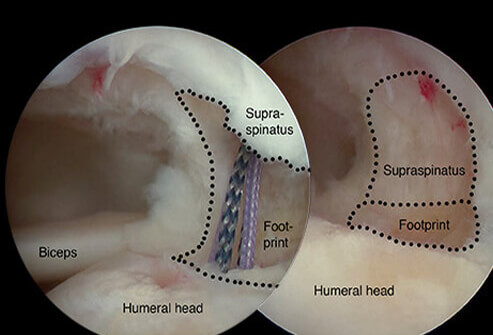
    Surgery may be recommended for a torn rotator cuff in severe cases. If pain does not improve with medical treatment and rest, or if you are an athlete or use your arms and shoulders a lot for work you may need surgery. Surgical options include an open repair, which involves a traditional surgical incision. This method is used for large or complex tears. Arthroscopic repair is less invasive and involves a smaller incision in which the surgeon inserts a small camera (an arthroscope) into the shoulder joint allowing the surgeon to see the shoulder anatomy and to guide surgical instruments.

    Either type of surgery involves an extensive rehabilitation period. This consists of immobilization of the shoulder joint, such as with a sling, for four to six weeks. Once the sling is off, physical therapy begins with passive exercises where a physical therapist will move the arm and shoulder for you. Beginning 8 to 12 weeks post-op you may start doing active physical therapy exercises to strengthen the arm.

    Can Rotator Cuff Injuries Be Prevented?

    You may not be able to prevent all causes of rotator cuff injuries. Accidents happen and muscles and tendons degenerate with age. But there are some things you can do to decrease the likelihood of a rotator cuff tear.

    • Proper warm-ups before sports or other tasks involving the shoulder joint can keep it flexible and may prevent injury.
    • Exercise the shoulder to maintain strength.
    • Avoid lifting heavy objects over your head.
    • If you are using your arms and shoulders a lot, take frequent breaks.

    Recovery & Prognosis

    In about half of patients with rotator cuff injuries, nonsurgical treatment is sufficient to relieve pain and restore shoulder function and movement. Conservative treatment generally consists of a minimum of six weeks of physical therapy and sometimes cortisone injections.

    If surgery is required, the recovery time is longer. The shoulder will need to be immobilized for four to six weeks, followed by physical therapy. Patients usually need to wait about three months before using the shoulder for light activities above shoulder height, and about six months to return to vigorous activities.

    0 comment
    0
    Facebook Twitter Google + Pinterest
    explainingmedicine

    previous post
    Lupus: Symptoms, Rash, and Treatment
    next post
    Bronchitis: Symptoms and Treatments

    Related Articles

    10 Worst Cities for Spring Allergies: Is Your City a Spring Allergy Capital?

    October 14, 2016

    Diet and Weight Loss: Healthy Dieting Myths and Facts

    October 14, 2016

    Children’s Health: 10 Ways to Raise Food-Smart Kids

    October 14, 2016

    Multiple Sclerosis: Diagnosing Multiple Sclerosis (MS)

    October 14, 2016

    Ear Infections: Treatments for Children & Adults

    October 14, 2016

    Zika Virus: Causes, Symptoms, Treatments

    October 14, 2016

    Cat Health: Behavioral Problems in Cats

    October 14, 2016

    Weight Loss: 24 Ways to Lose Weight Without Dieting

    October 14, 2016

    Osteoarthritis: Tips to Keep Joints Healthy

    October 14, 2016

    Osteoarthritis (OA): Treatment, Symptoms, Diagnosis

    October 14, 2016

    Recent Posts

    • Flu shot recommendation for kids dropped just as the illness rages

      January 12, 2026
    • The CDC just sidelined these childhood vaccines. Here’s what they prevent

      January 9, 2026
    • Your next primary care doctor could be online only, accessed through an AI tool

      January 9, 2026
    • In Lodge Grass, Montana, a Crow community works to rebuild from meth’s destruction

      January 8, 2026
    • RFK Jr.’s new dietary guidelines go all in on meat and dairy

      January 7, 2026

    Keep in touch

    Facebook Twitter Google + RSS

    Recent Posts

    • Flu shot recommendation for kids dropped just as the illness rages

      January 12, 2026
    • The CDC just sidelined these childhood vaccines. Here’s what they prevent

      January 9, 2026
    • Your next primary care doctor could be online only, accessed through an AI tool

      January 9, 2026
    • In Lodge Grass, Montana, a Crow community works to rebuild from meth’s destruction

      January 8, 2026
    • RFK Jr.’s new dietary guidelines go all in on meat and dairy

      January 7, 2026
    • Terms of Service
    • Privacy Policy

    @2026 - Explaining Medicine. All Right Reserved.


    Back To Top
    Explaining Medicine
    Proudly powered by WordPress Theme: soledad child.