Explaining Medicine
  • News
  • Health & Lifestyle
    • Diet & Weight Management
    • Exercise & Fitness
    • Nutrition, Food & Recipes
    • Prevention & Wellness
  • Conditions
    • Custom1
      • Conditions A-Z
      • Procedures A-Z
      • Allergies
      • Alzheimer’s
      • Arthritis
      • Asthma
      • Blood Pressure
      • Cholesterol
      • Cancer
    • Custom2
      • Chronic Pain
      • Cold Flu
      • Depression
      • Diabetes
      • Digestion
      • Eyesight
      • Health Living
      • Healthy Kids
      • Hearing Ear
    • Custom3
      • Heart
      • HIV/AIDS
      • Infectious Disease
      • Lung Conditions
      • Menopause
      • Men’s Health
      • Mental Health
      • Migraine
      • Neurology
    • Custom4
      • Oral Health
      • Pregnancy
      • Senior Health
      • Sexual Health
      • Skin Problems
      • Sleep
      • Thyroid
      • Travel Health
      • Women’s Health
  • Medications
    • Medications
    • Supplements and Vitamins
  • Medical Dictionary
  • Health Alerts
Flu shot recommendation for kids dropped just as...
The CDC just sidelined these childhood vaccines. Here’s...
Your next primary care doctor could be online...
In Lodge Grass, Montana, a Crow community works...
RFK Jr.’s new dietary guidelines go all in...
More seniors are becoming homeless. Shelters are trying...
Health officials slash the number of vaccines recommended...
Wegovy obesity pill now available at pharmacies
In the U.S., hunger is often hidden. But...
One doctor’s experience shows the battle for the...
Top Posts

Explaining Medicine

  • News
  • Health & Lifestyle
    • Diet & Weight Management
    • Exercise & Fitness
    • Nutrition, Food & Recipes
    • Prevention & Wellness
  • Conditions
    • Custom1
      • Conditions A-Z
      • Procedures A-Z
      • Allergies
      • Alzheimer’s
      • Arthritis
      • Asthma
      • Blood Pressure
      • Cholesterol
      • Cancer
    • Custom2
      • Chronic Pain
      • Cold Flu
      • Depression
      • Diabetes
      • Digestion
      • Eyesight
      • Health Living
      • Healthy Kids
      • Hearing Ear
    • Custom3
      • Heart
      • HIV/AIDS
      • Infectious Disease
      • Lung Conditions
      • Menopause
      • Men’s Health
      • Mental Health
      • Migraine
      • Neurology
    • Custom4
      • Oral Health
      • Pregnancy
      • Senior Health
      • Sexual Health
      • Skin Problems
      • Sleep
      • Thyroid
      • Travel Health
      • Women’s Health
  • Medications
    • Medications
    • Supplements and Vitamins
  • Medical Dictionary
  • Health Alerts
  • Slideshows

    Colorectal Cancer: Understanding Cancer of the Colon

    by explainingmedicine October 14, 2016

    What Is Colorectal Cancer?

    Colorectal cancer is the third most common non-skin cancer diagnosed in men and women in the U.S. It is also the second highest cause of cancer deaths. Still, colorectal cancer is highly curable when it is detected early enough. Colorectal cancer is a result of cancer cells that form in the lining of the colon (large intestine) or rectum.

    How Colorectal Cancer Starts

    Colorectal cancer often begins as a benign growth known as a polyp. Adenomas are a type of polyp and are benign tumors of the tissue lining the colon or rectum. Most polyps will stay benign, but some adenomas have the potential to turn into cancer over the long term. If they are removed early, this prevents them from turning in to cancer.

    Risk Factors You Can't Control

    Some risk factors for getting colorectal cancer are beyond your control. The following all increase the risk of getting colorectal cancer:

    • Inflammatory bowel disease
    • Colon polyps
    • Age over 50
    • Family history of colorectal cancer
    • History of breast or ovarian cancer

    Risk Factors You Can Control

    However, there are other risk factors for colorectal cancer that you can control. The following risk factors can be modified:

    • Eating a diet high in red or processed meat, or eating meat cooked at high temperatures
    • Overweight or obesity
    • Inadequate exercise
    • Cigarette smoking
    • Drinking alcohol

    Warning Signs of Colorectal Cancer

    Screening is important because colorectal cancer in its early stages usually doesn't produce any symptoms. Screening can detect the cancer before it produces symptoms, when it is most curable. After the disease begins to spread, it can produce blood in the stool, changes in bowel patterns (like diarrhea or constipation), abdominal pain, weight loss, or fatigue. Tumors that cause symptoms are typically larger and harder to treat.

    Screening for Colorectal Cancer

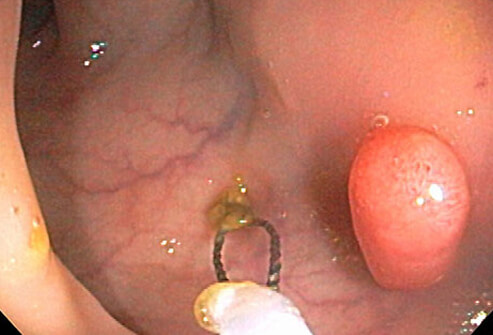
    It is recommended that most people have a screening colonoscopy every 10 years starting at age 50. A colonoscopy allows examination of the entire colon and rectum using a tiny camera. This test can find cancers in the early, most treatable stage and actually prevent cancers from developing by removing polyps, as shown here.

    What Is a Virtual Colonoscopy?

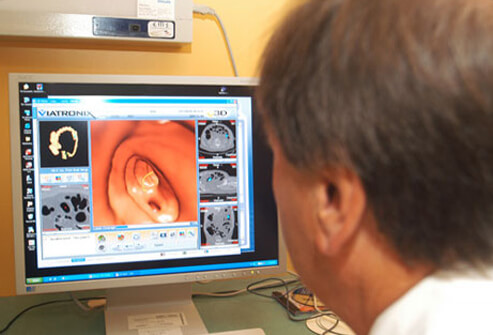
    An alternative to colonoscopy uses CT scan images to visualize the colon. This is known as a virtual colonoscopy. As with a conventional colonoscopy, the colon must be emptied as thoroughly as possible prior to the examination. In virtual colonoscopy, polyps or tumors are visualized without inserting the camera into the intestine. One disadvantage is that a virtual colonoscopy can only identify and not remove any polyps that are found. A real colonoscopy is needed to remove polyps that may be identified.

    Colon X-Rays (Lower GI)

    An X-ray of the colon, known as a lower GI series, can provide another way to image the colon and rectum. A chalky liquid known as barium is used as a contrast agent. This photo shows an example of an "apple core" tumor that narrows the colon. As with a virtual colonoscopy, a real colonoscopy or other surgical procedure would be needed to remove any tumors or polyps that may be found.

    Colorectal Cancer Diagnosis

    If there are abnormalities seen in your colon or rectum, a biopsy is done to determine whether cancer is present. This can be done during a colonoscopy. The tissue is examined microscopically to look for cancer cells. This picture shows a highly magnified view of colon cancer cells.

    Colorectal Cancer Staging

    Staging is the process of determining how far a tumor has spread beyond its original location. Staging may not be related to the size of the tumor. Treatment decisions also depend upon the stage of a tumor. Staging for colorectal cancer is as follows:

    • Stage 0 – The cancer is found only in the innermost lining of the rectum or colon.
    • Stage I – The cancer has not spread beyond the inner wall of the rectum or colon.
    • Stage II – The cancer has spread into the muscle layer of the rectum or colon.
    • Stage III – The cancer has spread to at least one lymph node in the area.
    • Stage IV – The cancer has spread to distant sites in the body, such as the bones, liver, or lungs. This stage is NOT dependent on how far the tumor has penetrated or if the cancer has spread to lymph nodes near the tumor.

    Survival Rates for Colorectal Cancer

    Higher stages mean that a cancer is more serious and has a worse prognosis. Patients with stage I colorectal cancer have a 5-year survival rate of 74%, while that rate drops to 6% for Stage IV tumors.

    Colorectal Cancer Surgery

    Except for very advanced cases, colorectal cancer is usually treated by surgically removing the tumor and surrounding tissues. Surgery has a very high cure rate for early stage tumors. For advanced tumors that have spread outside the colon, surgery does not typically cure the condition, but removing larger tumors may reduce symptoms.

    Advanced Colorectal Cancer Treatment

    Colorectal cancer that has spread to the lymph nodes (stage III) can sometimes still be cured. In this case treatment usually consists of surgery and chemotherapy for colon cancer. In cases of rectal cancer, radiation therapy is added both prior to and following surgery in more advanced cases. Cancers that return after treatment or spread to other organs are harder to treat and more difficult to cure, but treatments may relieve symptoms and prolong life.

    0 comment
    0
    Facebook Twitter Google + Pinterest
    explainingmedicine

    previous post
    Breast Cancer: Diagnosis and Treatment
    next post
    Baby Health: The Facts About Bottle Feeding

    Related Articles

    Parenting: 10 Mistakes New Parents Make

    October 14, 2016

    Balance Disorders: Vertigo, Migraines, Motion Sickness and More

    October 14, 2016

    Rotator Cuff Injury: Causes, Symptoms, and Surgery

    October 14, 2016

    Viral Infections: Types, Treatment, and Prevention

    October 14, 2016

    Healthy Eating: Food Cravings That Wreck Your Diet

    October 15, 2016

    Grocery Smarts: Fat Foods vs. Fit Foods

    October 14, 2016

    Osteoporosis: Are Your Bones at Risk?

    October 14, 2016

    Hair and Beauty: Best Hairstyles for Your Hair Type

    October 15, 2016

    Senior Health: 18 Secrets for a Longer Life

    October 14, 2016

    Nail Health: What Your Nails Say about Your Health

    October 14, 2016

    Recent Posts

    • Flu shot recommendation for kids dropped just as the illness rages

      January 12, 2026
    • The CDC just sidelined these childhood vaccines. Here’s what they prevent

      January 9, 2026
    • Your next primary care doctor could be online only, accessed through an AI tool

      January 9, 2026
    • In Lodge Grass, Montana, a Crow community works to rebuild from meth’s destruction

      January 8, 2026
    • RFK Jr.’s new dietary guidelines go all in on meat and dairy

      January 7, 2026

    Keep in touch

    Facebook Twitter Google + RSS

    Recent Posts

    • Flu shot recommendation for kids dropped just as the illness rages

      January 12, 2026
    • The CDC just sidelined these childhood vaccines. Here’s what they prevent

      January 9, 2026
    • Your next primary care doctor could be online only, accessed through an AI tool

      January 9, 2026
    • In Lodge Grass, Montana, a Crow community works to rebuild from meth’s destruction

      January 8, 2026
    • RFK Jr.’s new dietary guidelines go all in on meat and dairy

      January 7, 2026
    • Terms of Service
    • Privacy Policy

    @2026 - Explaining Medicine. All Right Reserved.


    Back To Top
    Explaining Medicine
    Proudly powered by WordPress Theme: soledad child.