Explaining Medicine
  • News
  • Health & Lifestyle
    • Diet & Weight Management
    • Exercise & Fitness
    • Nutrition, Food & Recipes
    • Prevention & Wellness
  • Conditions
    • Custom1
      • Conditions A-Z
      • Procedures A-Z
      • Allergies
      • Alzheimer’s
      • Arthritis
      • Asthma
      • Blood Pressure
      • Cholesterol
      • Cancer
    • Custom2
      • Chronic Pain
      • Cold Flu
      • Depression
      • Diabetes
      • Digestion
      • Eyesight
      • Health Living
      • Healthy Kids
      • Hearing Ear
    • Custom3
      • Heart
      • HIV/AIDS
      • Infectious Disease
      • Lung Conditions
      • Menopause
      • Men’s Health
      • Mental Health
      • Migraine
      • Neurology
    • Custom4
      • Oral Health
      • Pregnancy
      • Senior Health
      • Sexual Health
      • Skin Problems
      • Sleep
      • Thyroid
      • Travel Health
      • Women’s Health
  • Medications
    • Medications
    • Supplements and Vitamins
  • Medical Dictionary
  • Health Alerts
Flu shot recommendation for kids dropped just as...
The CDC just sidelined these childhood vaccines. Here’s...
Your next primary care doctor could be online...
In Lodge Grass, Montana, a Crow community works...
RFK Jr.’s new dietary guidelines go all in...
More seniors are becoming homeless. Shelters are trying...
Health officials slash the number of vaccines recommended...
Wegovy obesity pill now available at pharmacies
In the U.S., hunger is often hidden. But...
One doctor’s experience shows the battle for the...
Top Posts

Explaining Medicine

  • News
  • Health & Lifestyle
    • Diet & Weight Management
    • Exercise & Fitness
    • Nutrition, Food & Recipes
    • Prevention & Wellness
  • Conditions
    • Custom1
      • Conditions A-Z
      • Procedures A-Z
      • Allergies
      • Alzheimer’s
      • Arthritis
      • Asthma
      • Blood Pressure
      • Cholesterol
      • Cancer
    • Custom2
      • Chronic Pain
      • Cold Flu
      • Depression
      • Diabetes
      • Digestion
      • Eyesight
      • Health Living
      • Healthy Kids
      • Hearing Ear
    • Custom3
      • Heart
      • HIV/AIDS
      • Infectious Disease
      • Lung Conditions
      • Menopause
      • Men’s Health
      • Mental Health
      • Migraine
      • Neurology
    • Custom4
      • Oral Health
      • Pregnancy
      • Senior Health
      • Sexual Health
      • Skin Problems
      • Sleep
      • Thyroid
      • Travel Health
      • Women’s Health
  • Medications
    • Medications
    • Supplements and Vitamins
  • Medical Dictionary
  • Health Alerts
  • Slideshows

    Crohn’s Disease: Symptoms, Causes and Treatment

    by explainingmedicine October 14, 2016

    What is Crohn's Disease?

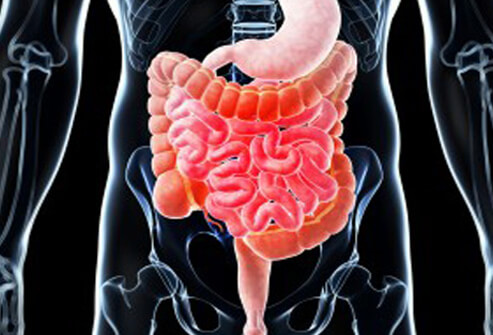
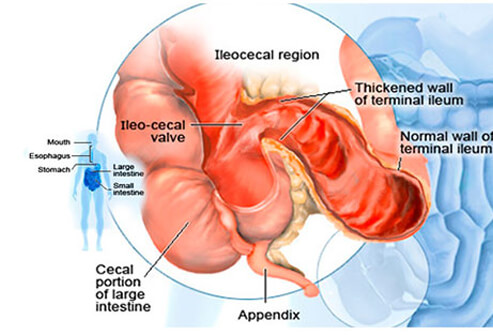
    Crohn's (or Crohn) disease is a disease that usually affects the small intestine and less commonly the colon, but it is capable of involving the remainder of the gastrointestinal tract - the mouth, esophagus, and stomach. The chronic inflammation that is the basis of Crohn's disease causes ulceration, swelling, and scarring of the parts of the intestine that it involves. Other names for Crohn's disease include granulomatous enteritis, regional enteritis, ileitis, and granulomatous colitis when it involves the colon.


    What Causes Crohn's Disease?

    The cause of the chronic inflammation in Crohn's disease is unknown. The leading theory is that inflammation is initiated by bacteria that reside within the intestine. Whereas most inflammation usually is suppressed and the disease caused by the inflammation subsides, in Crohn's disease the inflammation is not suppressed, and the inflammation continues. The continuing inflammation probably occurs because of environmental factors (i.e., the bacteria) as well as genetic factors that affect the immune system.

    Crohn's Disease in Children & Teens

    Crohn's disease most commonly affects children in their late teens and young adults in their 20s and 30s. Nevertheless, it can affect infants and young children as well. Crohn's disease is not rare; 100,000 teens and preteens in the U.S. have Crohn's disease. For children, the social problems created by the symptoms of Crohn's disease are difficult to deal with since the disease can restrict activities. The chronic inflammation also stunts growth and delays puberty that add to the social difficulties. Emotional and psychological factors always must be considered in young people with Crohn's disease.

    How Does Crohn's Disease Affect the Intestines?

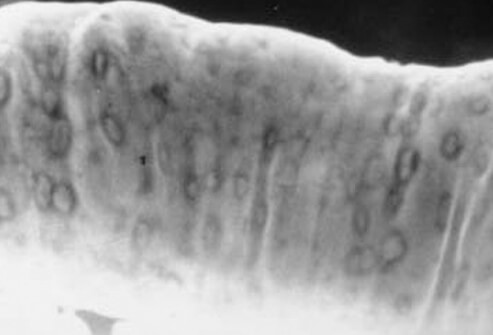
    The first signs of Crohn's disease are small ulcers, called aphthous ulcers, caused by breaks in the lining of the intestine due to inflammation. The ulcers become larger and deeper. With the expansion of the ulcers comes swelling of the tissue, and finally scarring of the intestine that causes stiffness and narrowing. Ultimately, the narrowing can cause obstruction to the flow of digesting food through the intestines. The deepening ulcers can fully penetrate the intestinal wall and enter nearby structures such as the urinary bladder, vagina, and other parts of the intestine. These penetrating tracts of inflammation are called fistulas.

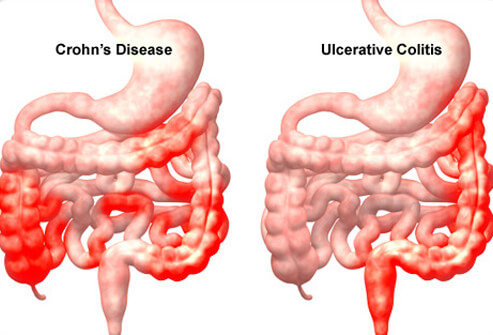
    How is Crohn's Disease Different from Ulcerative Colitis?

    Both Crohn's disease and ulcerative colitis are chronic diseases of intestinal inflammation. Whereas ulcerative colitis only involves the colonic portion of the gastrointestinal tract, Crohn's disease can affect any portion of the gastrointestinal tract from mouth to anus.

    Whereas the inflammation of ulcerative colitis involves only the superficial lining of the colon, the inflammation of Crohn's disease goes deeper into the intestinal walls and, as previously mentioned, even beyond the walls.

    Inflammation in ulcerative colitis is continuous, that is, the inflammation does not skip areas. Thus, the colon is involved from the most proximal margin of the inflammation - be that ascending, transverse or sigmoid colon - all the way to the anus. On the other hand, the inflammation of Crohn's disease can be present in several portions of the intestines with skipped areas without inflammation in between.

    Symptoms of Crohn's Disease

    The most common symptoms of Crohn's disease are abdominal pain and diarrhea. Other signs of inflammation frequently are present including fever and abdominal tenderness. Because symptoms can be worsened by eating, the intake of food is reduced, and this leads to loss of weight, and, less commonly, nutritional deficiencies. Slow continuous loss of blood into the intestine that may not even be recognizable in the stool can lead to iron deficiency anemia.

    Complications of Crohn's Disease

    Several complications of Crohn's disease have already been mentioned, including nutritional deficiencies, loss of weight, anemia, growth retardation, and delayed puberty. Two more serious complications also mentioned previously are strictures or narrowing of the intestine due to scarring and the formation of fistulas. Massive intestinal bleeding and perforation are unusual.

    Other Complications of Crohn's Disease

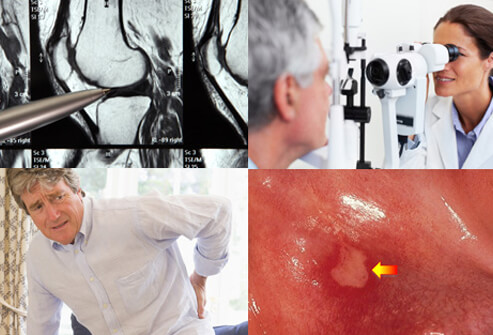
    There are also extraintestinal manifestations of Crohn's disease, some of which may be debilitating. These include arthritis, inflammation of the eye that can impair vision, skin diseases that vary from mild (erythema nodosum) to severe (pyoderma gangrenosum) gallstones, and loss of bone due to nutritional deficiencies. Most of these manifestations are believed to be due to inflammation that is occurring outside of the intestine.

    Diagnosing Crohn's Disease

    Although Crohn's disease usually is not difficult to diagnose, the wide variation in severity of symptoms - from mild to severe - and the non-specific nature of the symptoms that mimic other intestinal inflammatory diseases (for example, diverticulitis), sometimes makes arriving at a diagnosis challenging.

    • The pattern of the symptoms and a family history of Crohn’s disease are very important in diagnosis.
    • Often, other more common intestinal inflammatory diseases need to be excluded, for example, intestinal bacterial and parasitic infections.
    • Stool may be examined for signs of inflammation such as blood or white blood cells. Fever and an elevated white blood cell count in the blood may suggest inflammation somewhere in the body.
    • Ultimately the inflamed bowel must be visualized and, if possible, biopsied. This can be done by barium X-ray studies, particularly a small intestinal barium X-ray, but probably better by colonoscopy with examination of the terminal ileum (which usually is involved in Crohn’s disease) that also allows for biopsies.
    • When inflammation does not involve the terminal ileum, it may be necessary to do capsule endoscopy (the swallowing of a tiny camera) or enteroscopy (fiberoptic endoscopy of the small intestine) to visualize the entire small intestine. Enteroscopy has the advantage over capsule endoscopy of allowing for biopsy as well as visualization.

    Treating Crohn's Disease

    Treatment of Crohn's disease is directed at reducing inflammation - treating flares in the activity of the disease, and maintaining remissions. The type of medication that is used depends on the severity of the inflammation and how well the disease responds to initial treatment. If inflammation does not decrease with initial treatment, more powerful medications are used though the risks for serious side effects increase. With severe disease, the more powerful medications may be used immediately.

    Surgery in Crohn's Disease

    Surgery is avoided in Crohn's disease if at all possible because of the high probability that inflammation will recur even when it appears that all inflammation has been removed during surgery. There are situations in which surgery often becomes necessary such as with strictures, intestinal obstruction, or symptoms that do not respond to any medical treatment. Usually, the surgery that is done is kept to the minimum that is necessary to take care of the complication. Surgery may include removal of parts of the intestine, stretching of strictures, and removal of fistulas but at times may require resection of the entire colon and the need for a colostomy or ileostomy.

    Medication Choices

    The treatment of choice for Crohn's disease is medication to control the inflammation. The primary goal is to relieve symptoms by treating flares and putting the disease into remission. A secondary goal is to postpone or prevent surgery. The choice of medication depends on the severity of the flare, the location of the inflammation, and the presence of complications of the disease.

    • Aminosalicylates and antibiotics suppress inflammation and are associated with the fewest side effects.
    • Corticosteroids are very effective at suppressing inflammation but are associated with serious side effects when used for prolonged periods of time.
    • Other medications suppress the immune system in general and can be used for prolonged periods of time.
    • Biologics are injectable medications that reduce inflammation by blocking the action of specific chemicals that are released by immune cells that provoke inflammation.

    Other Therapy

    Newer suppressors of inflammation and the immune system are being developed all of the time. Two general immunosuppressants are tacrolimus (Prograf, FK 506) and mycophenolate mofetil (CellCept). Newer biologics also are being developed.

    Diet and Nutrition in Crohn's Disease

    Maintaining good nutrition with Crohn's disease can be a challenge. Weight loss as well as specific vitamin and mineral deficiencies (for example, iron deficiency anemia) may occur. Patients whose inflammation still is active do not have much of an appetite so their intake of food is reduced or the types of foods they eat are restricted. Eating also makes the symptoms worse so they eat less. Finally, if a substantial portion of the small intestine is inflamed or surgically removed, the inflamed intestine may not absorb nutrients normally. Good nutrition depends on the control of inflammation, but when that is not achievable, it depends on supplemental vitamins, minerals, and calories.

    Will I Have to Change My Diet?

    No specific foods are believed to provoke the symptoms of Crohn's disease, although it always is recommended that if certain foods seem to exacerbate symptoms then those foods should be eliminated from the diet. The most commonly recommended dietary changes are reduced intake of milk and dairy products, but this recommendation is based primarily on the possibility of lactose intolerance, a genetic abnormality of milk sugar digestion that is unrelated to Crohn's disease. If the relationship between milk and symptoms is not clear, it probably is a good idea to do a formal lactose tolerance test to learn for certain whether or not milk and milk products should be eliminated from the diet. It would be a shame to eliminate milk from the diet unless absolutely necessary since milk is an excellent source of calories, protein, vitamin D, and calcium.

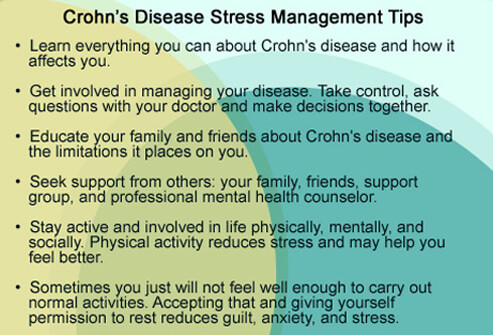
    Coping with Stress

    Active Crohn's disease provides many stresses, and stress makes the symptoms of all diseases worse, including Crohn's disease. The best treatment for the stress is successful suppression of inflammation. When inflammation cannot be suppressed, patients become depressed and angry. This interferes with relationships with friends and families, and it may be helpful to use support groups to help relieve some of the stresses caused by the disease. It also is important to stay as active as possible, readjusting activities to work around symptoms. Adequate rest is very important.

    Crohn's Disease Outlook

    For most patients, Crohn's disease is a chronic illness with flares of disease activity and remissions. Appropriate medications, and occasionally surgery, however, will provide a reasonable quality of life for most patients. If there is progression of the symptoms of Crohn's disease the progression usually is slow. The longer the disease is present the more likely are complications, some of which will require surgery (for example, strictures). In fact, surgery is required by most patients at some point in their disease. It is important to remember that Crohn's disease usually recurs after surgery even if all visible inflammation is removed.

    0 comment
    0
    Facebook Twitter Google + Pinterest
    explainingmedicine

    previous post
    Weight Loss: Top 10 Habits That Can Help You Lose Weight
    next post
    Pinworms: Symptoms, Treatments, and Medication

    Related Articles

    Fungal Infections: Fungus Among Us

    October 14, 2016

    Gout: See & Learn About Gouty Arthritis Attacks

    October 14, 2016

    Energy Foods: A Diet to Boost Your Mood & Energy Level

    October 14, 2016

    Skin and Beauty: Foods for Healthy Skin

    October 14, 2016

    Early Pregnancy Symptoms: Could You Be Pregnant?

    October 14, 2016

    MRSA: How Much Do You Know About This “Superbug”?

    October 14, 2016

    Skin and Beauty: Skin Care Tips for Teen Girls

    October 14, 2016

    Diet and Weight Loss: Surprising Sources of Hidden Sugar

    October 14, 2016

    Salmonella Outbreak: See How to Avoid It

    October 14, 2016

    Baby Skin Care: 11 Common Causes of Skin Rashes

    October 14, 2016

    Recent Posts

    • Flu shot recommendation for kids dropped just as the illness rages

      January 12, 2026
    • The CDC just sidelined these childhood vaccines. Here’s what they prevent

      January 9, 2026
    • Your next primary care doctor could be online only, accessed through an AI tool

      January 9, 2026
    • In Lodge Grass, Montana, a Crow community works to rebuild from meth’s destruction

      January 8, 2026
    • RFK Jr.’s new dietary guidelines go all in on meat and dairy

      January 7, 2026

    Keep in touch

    Facebook Twitter Google + RSS

    Recent Posts

    • Flu shot recommendation for kids dropped just as the illness rages

      January 12, 2026
    • The CDC just sidelined these childhood vaccines. Here’s what they prevent

      January 9, 2026
    • Your next primary care doctor could be online only, accessed through an AI tool

      January 9, 2026
    • In Lodge Grass, Montana, a Crow community works to rebuild from meth’s destruction

      January 8, 2026
    • RFK Jr.’s new dietary guidelines go all in on meat and dairy

      January 7, 2026
    • Terms of Service
    • Privacy Policy

    @2026 - Explaining Medicine. All Right Reserved.


    Back To Top
    Explaining Medicine
    Proudly powered by WordPress Theme: soledad child.